


Since the first days of Spanish colonization, San Antonio has been one of the centerpieces at the heart of Texas. Joining DFW and Houston as an important third of the Texas Triangle, Bexar County represents some of the most important cities and industries in the Lone Star State. While Austin and Travis County may have stolen the limelight in the area over the past decade, Bexar County is still one of the top rising areas in the nation, with a demand for homes and businesses to match. With growing aggression from the Bexar Appraisal District (BCAD), taxpayers in San Antonio and the surrounding area have been using property tax protests like never before. Thankfully, these appeals are highly successful, and the vast majority of protesters see a reduction.
Bexar County Homes Slightly Shed Value
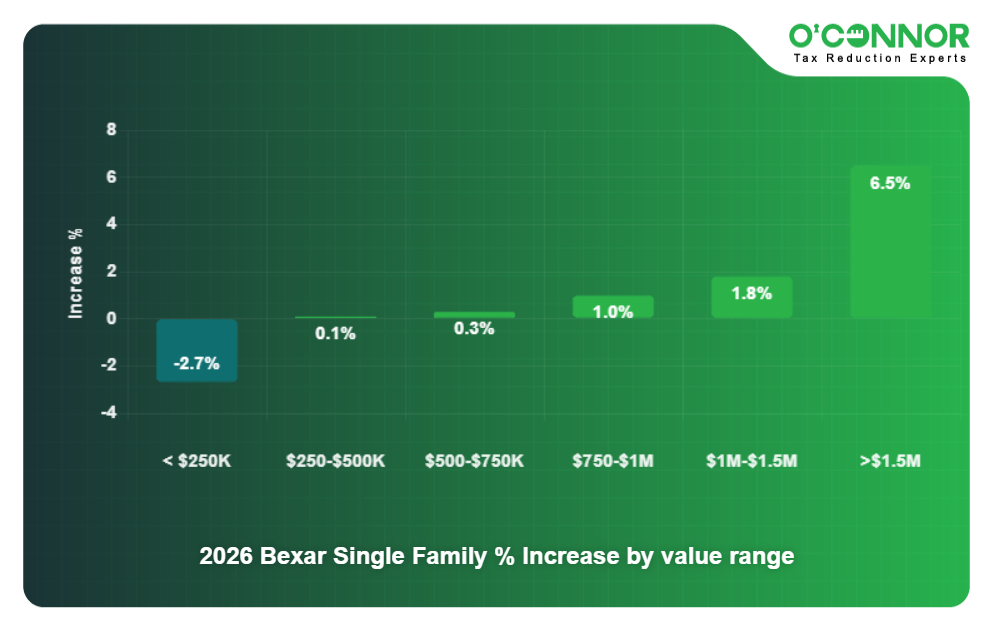
While Bexar County property taxes have doubled in the past decade, home prices have leveled off somewhat in the past few years. In 2025, home values only increased by 2.2%. In 2026, however, they saw a small reduction of 0.4%. This small fall was mostly thanks to a reduction of 2.7% for homes worth under $250,000, as they were the second-largest source of value in the county at $52.50 billion. The largest reservoir of value, homes valued between $250,000 and $500,000, only added 0.1% to their value, reaching $84.55 billion. Expensive homes across the county saw some growth, though they contributed to the total value by a small amount. Homes worth over $1.5 million added 6.5%, translating into a final sum of $6.53 billion.
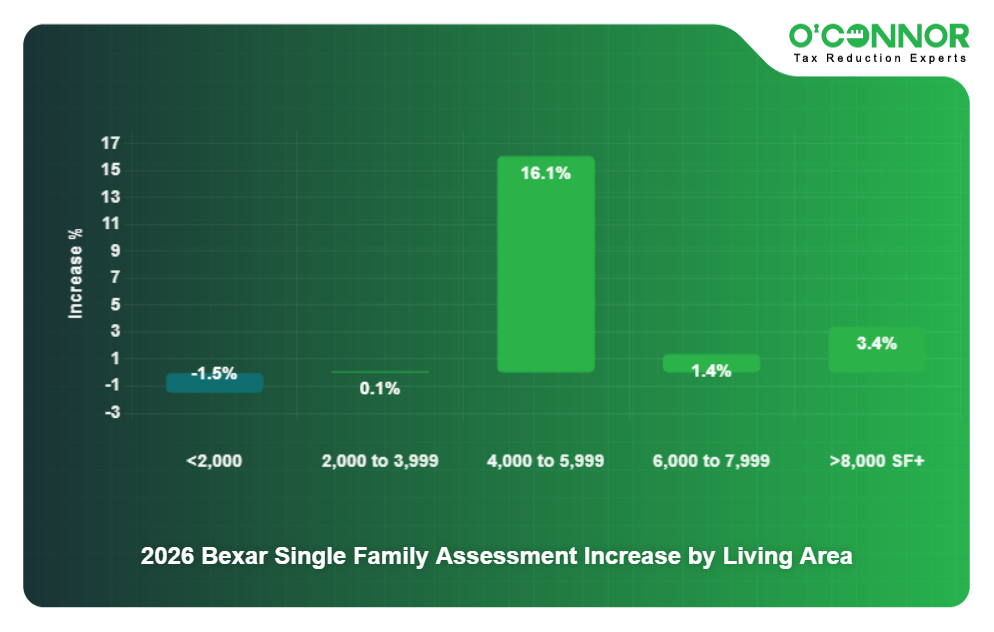
While many rising counties are focused on McMansions, Bexar still keeps to its roots. The two largest categories of value were both modest homes. Those under 2,000 square feet accounted for $81.23 billion, while those between 2,000 and 3,999 square feet were responsible for $90.28 billion. The smallest homes saw a reduction of 1.5%, while the medium homes only increased by 0.1%. Homes measured between 4,000 and 5,999 square feet added 16.1%, bringing the total to $1.75 billion. Growing by 1.4%, those from 6,000 to 7,999 square feet totaled $11.74 billion. True mansions jumped 3.4% to $1.98 billion.
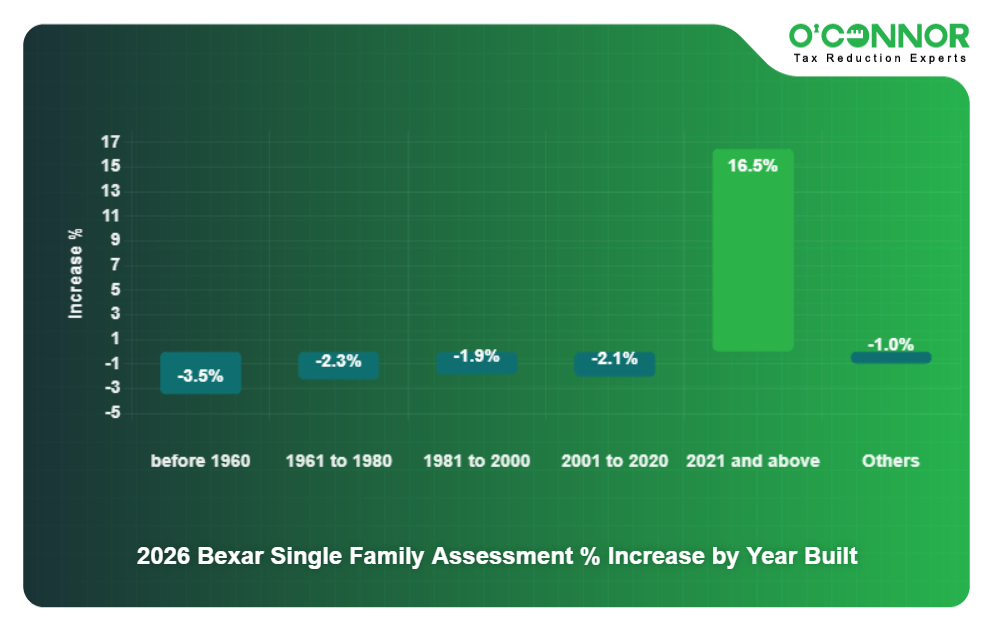
When broken down by age of construction, the reasons for the overall decrease can be seen. New construction saw an increase of 16.5% and accounted for a total of $21.96 billion, roughly 12% of the total. All other eras of construction saw their totals fall. Those built from 2001 to 2020, the largest collection of value, fell 2.1% to $69.61 billion. Those from 1981 to 2000 dropped 1.97% to $41.18 billion. The oldest homes in the county fell 3.5% to $25.51 billion. Even raw land regressed 1%. This clearly demonstrates that new construction is keeping the overall total somewhat afloat.
45% of San Antonio Area Homes Overvalued
Houses Valued above/below Market Value based on Jan 2025 – Mar 2026 Sales
Despite the overall drop in values, it is estimated that around 45% of homes are still overvalued. This is determined by comparing recent home sales to BCAD numbers. BCAD determines the market value of homes by using previous records of sales, but these can often be out of date. This is one of the most common grounds for a property tax protest, and appeals for overappraisal can be successful if backed by solid sales records.
Home Sales up 14.3% in Value to Start 2026
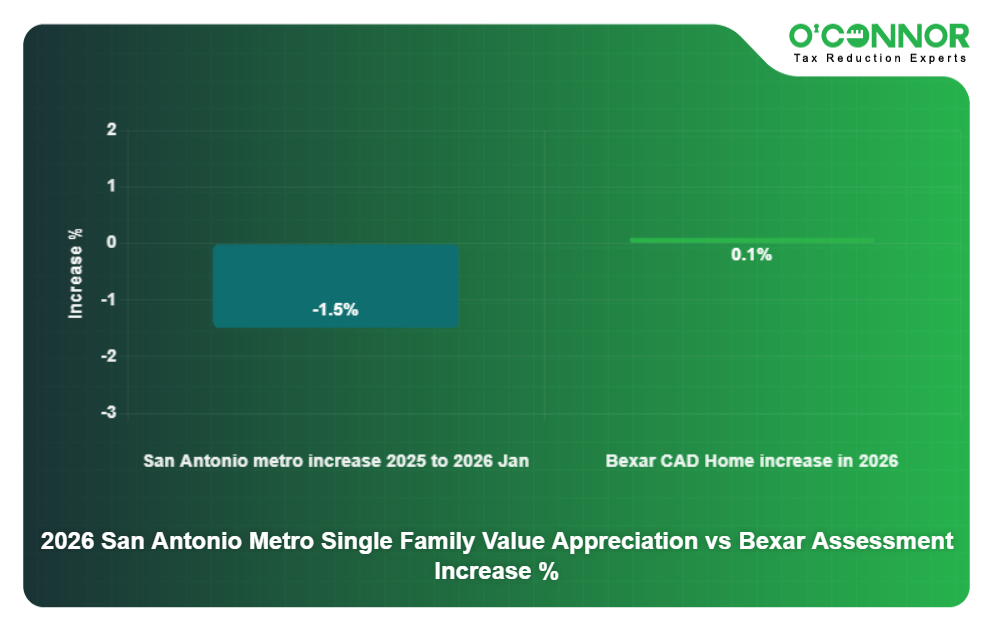
While BCAD’s numbers are down, a study by San Antonio realtors showed that sales for the start of 2026 have been higher in value than expected. This showed that home prices had actually increased 14.3%, rather than falling 0.4%. BCAD is behind the actual market, so it is understandable that their values would lag behind. While initially good for homeowners in Bexar County, this could mean that taxable home values will climb in the coming years.
Commercial Property Surges 4.2%
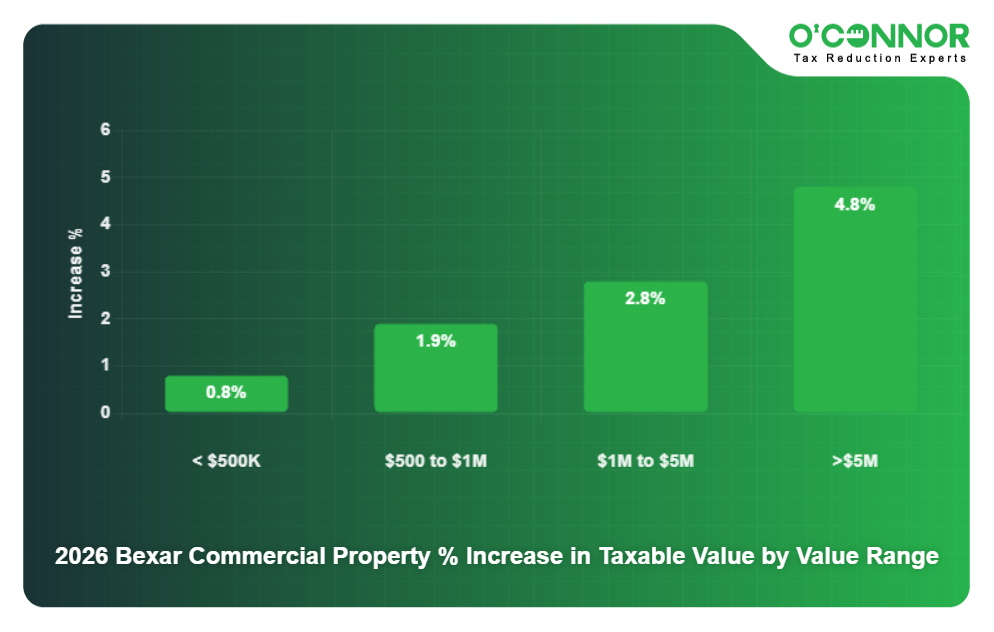
While home values generally retreated, the same cannot be said for commercial real estate. The noticed market value increased by 4.2% in 2026. This was mainly thanks to an increase of 4.3% for business properties worth over $5 million, which resulted in a final tally of $40.51 billion. These large businesses usually control the majority of value. Business real estate worth between $1 million and $5 million increased 2.8% to $9.70 billion. Those worth between $500,000 and $1 million climbed 1.9% to $2.19 billion, while the smallest businesses edged up 0.8%.
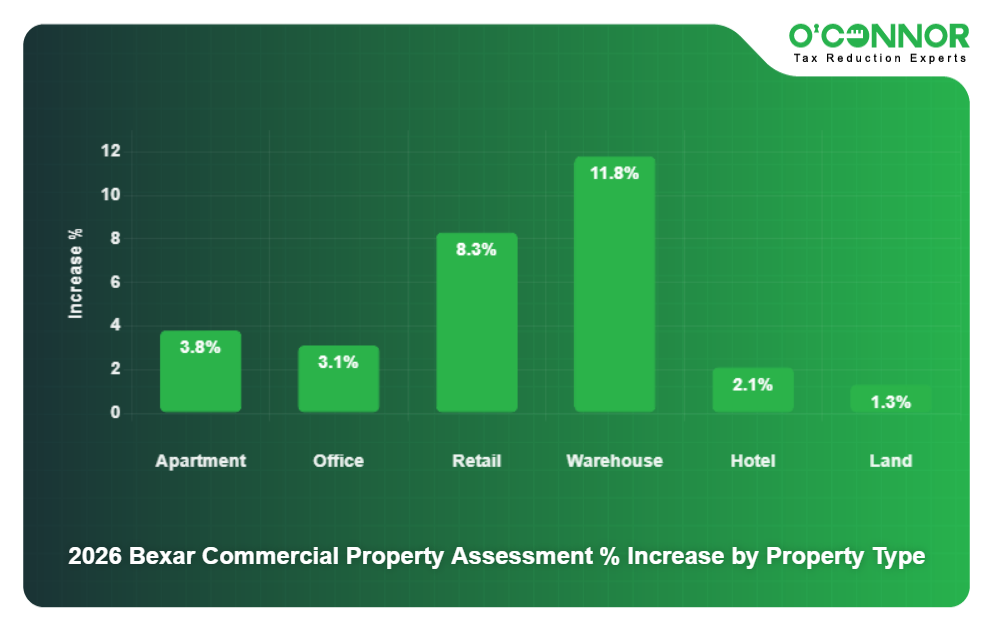
Like most urban counties, the majority of Bexar’s commercial value came from apartments. Adding 3.8%, apartments reached a new total of $23.09 billion. Jumping 8.3%, retail took second place with $8.83 billion, while offices totaled $7.96 billion following a boost of 3.1%. Warehouses increased the most at 11.8%, totaling $2.11 billion. Hotels and raw land grew by 2.1% and 1.3%, respectively.
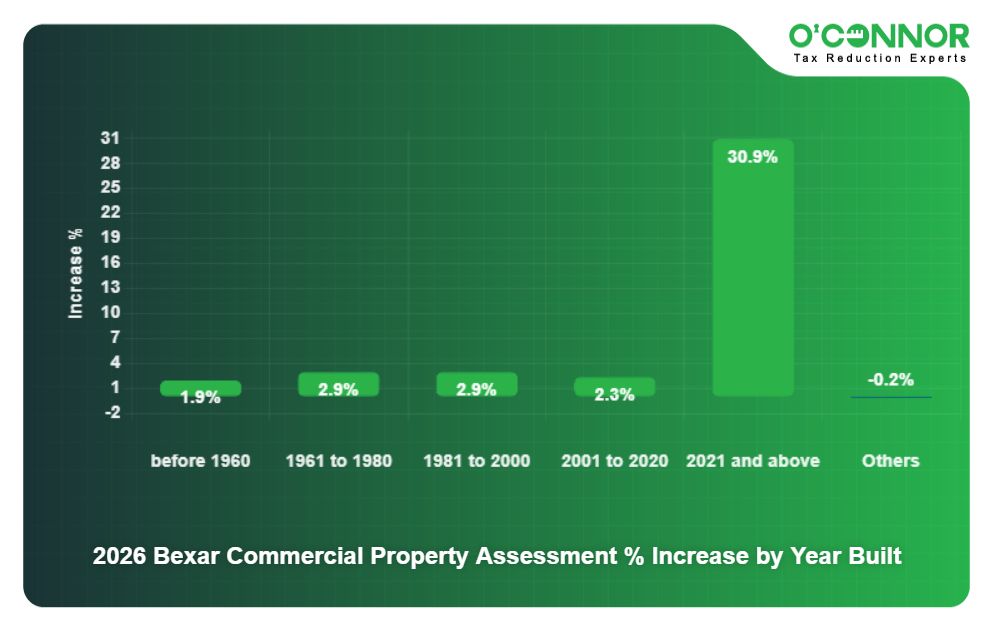
Unlike homes, with the exception of raw land, no era of construction saw a regression. Like most of Texas, the most value came from the boom period of 2001 to 2020, which totaled $22.32 billion following an increase of 2.3%. Those built from 1981 to 2000 accounted for $12.04 billion, which was achieved thanks to a boost of 2.9%. New construction added 30.9% to its total, reaching $4.80 billion, roughly 9% of all value. Those from 1961 to 1980 added 2.9% to bring the total to $5.67 billion, while the oldest businesses added 1.9%.
Bexar County Commercial Real Estate Higher Than the National Average
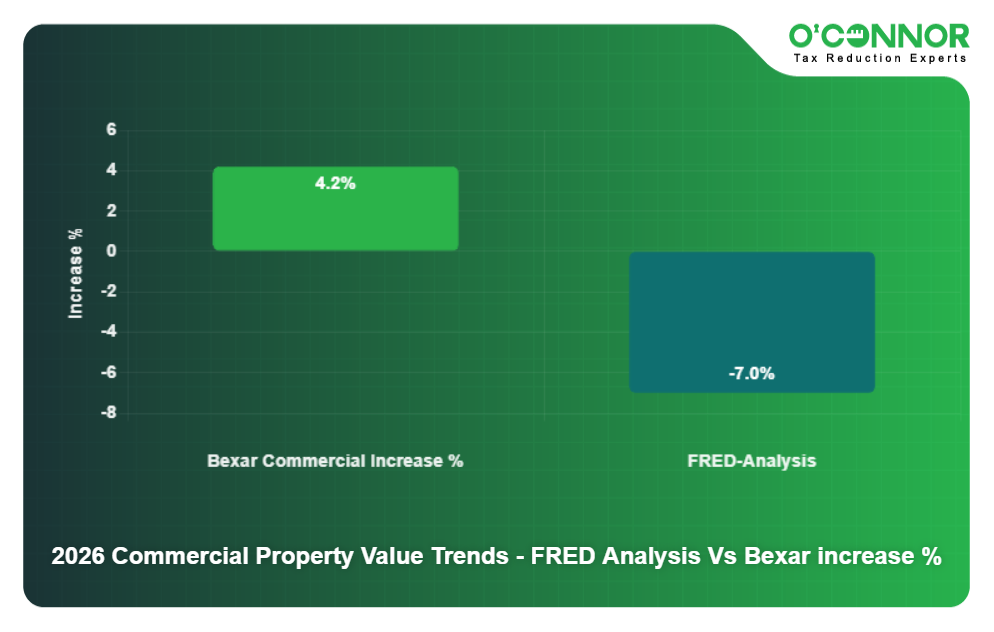
Thanks to a study by the Federal Reserve of St. Louis (FRED), it was determined that commercial property across the nation had depreciated 7% over the past few years. This was particularly felt in offices after the pandemic. This was obviously much lower than the 4.2% that BCAD appraised for businesses in Bexar County. While the Texas economy is booming, with the decrease in home values in mind, these numbers could be inflated. This is why businesses should appeal every year, just to be sure they are paying the fair amount.
Apartments Remain King
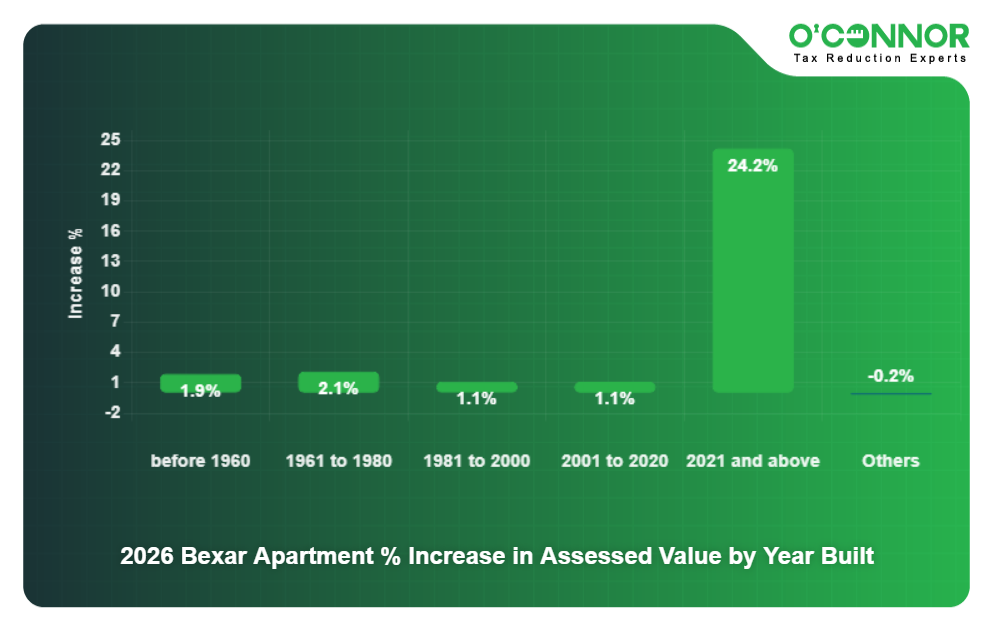
Already the most valuable commercial properties, apartments added 3.8% in 2026. 50% of all apartment value was built from 2001 to 2020, which added 1.1% to total $11.57 billion. Growing by 1.1%, those from 1981 to 2000 reached a total of $5.22 billion. Soaring by 24.2%, new construction was in third place with $3.04 billion. Fourth place went to those built from 1961 to 1980, which added 2.1%. Older apartments and raw land combined for around 2% of the total.
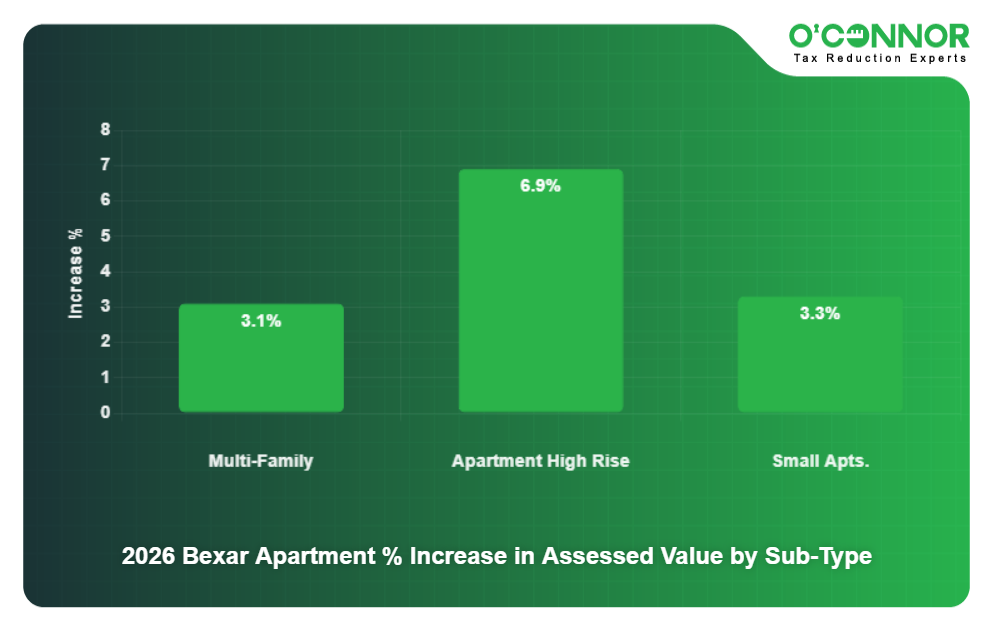
BCAD divided apartments into three categories. The largest was multifamily housing at $18.16 billion, which had grown 3.1%. High-rise apartments surged by 6.9%, resulting in a final tally of $4.37 billion. Small apartments totaled $568.38 million following an increase of 3.3%.
Offices Jump by 3.1%
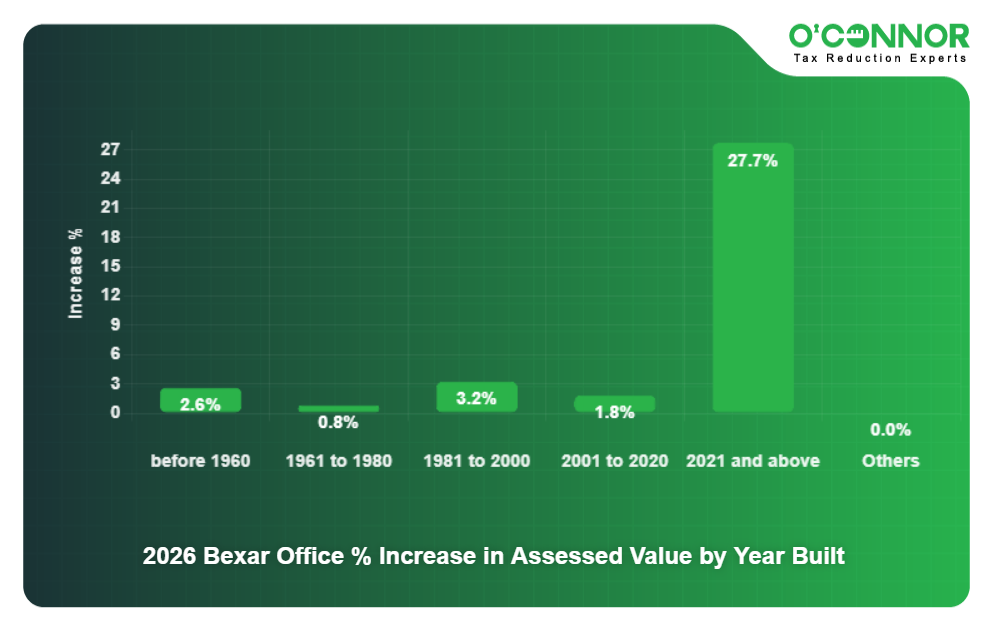
Offices often have a hard time holding onto value due to changing work habits, but they have largely hung on in Bexar County. Adding 3.1% to an overall total of $7.96 billion, offices improved beyond inflation. 45% of all value came from the boom period of 2001 to 2020, which added another 1.8%. Those from 1981 to 2000 grew 3.2% to $2.77 billion, while those from 1961 to 1980 contributed $843.05 million following a slight uptick of 0.8%. New construction added 27.7% to its value, but only accounted for $340.11 million.
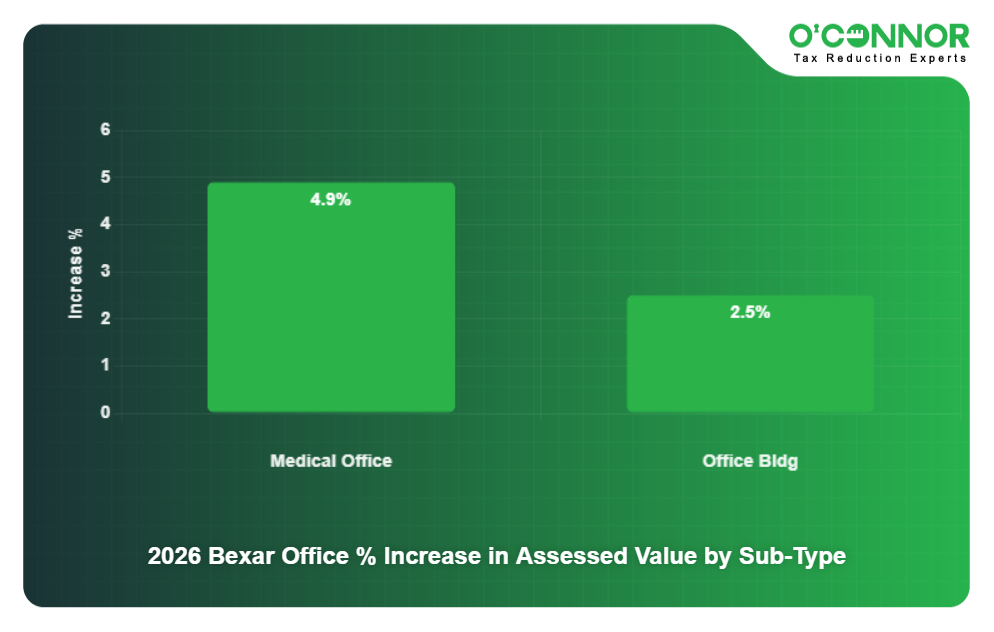
There were only two categories of offices according to BCAD. Office buildings added 2.5% to reach a new total of $5.81 billion. Medical offices grew by 4.9% to reach a final sum of $2.16 billion.
Retail Soars by 8.3%
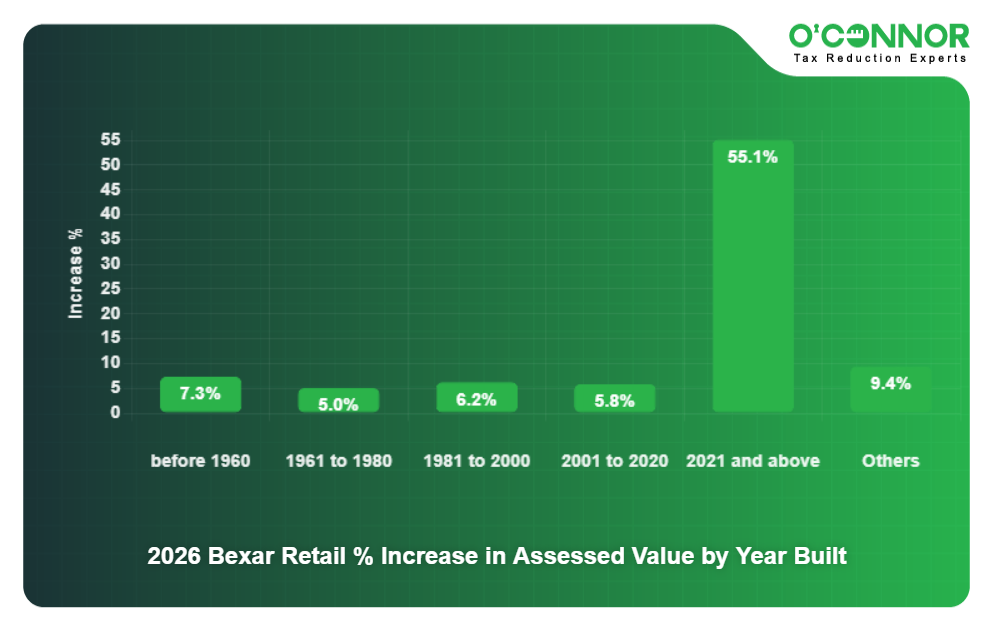
Contributing $8.83 billion, retail has a larger impact on commercial value in Bexar County than it does in most of Texas. This total grew by 8.3% in 2026. The same pattern established for other pieces of commercial real estate continued, with most of the value being built from 2001 to 2020, which accounted for $4 billion. Adding 6.2%, those from 1981 to 2000 were responsible for $2.11 billion, while those from 1961 to 1980 contributed $1.39 billion. These had grown by 6.2% and 5%, respectively. New construction soared by 55.1%, and was responsible for $605.85 million.
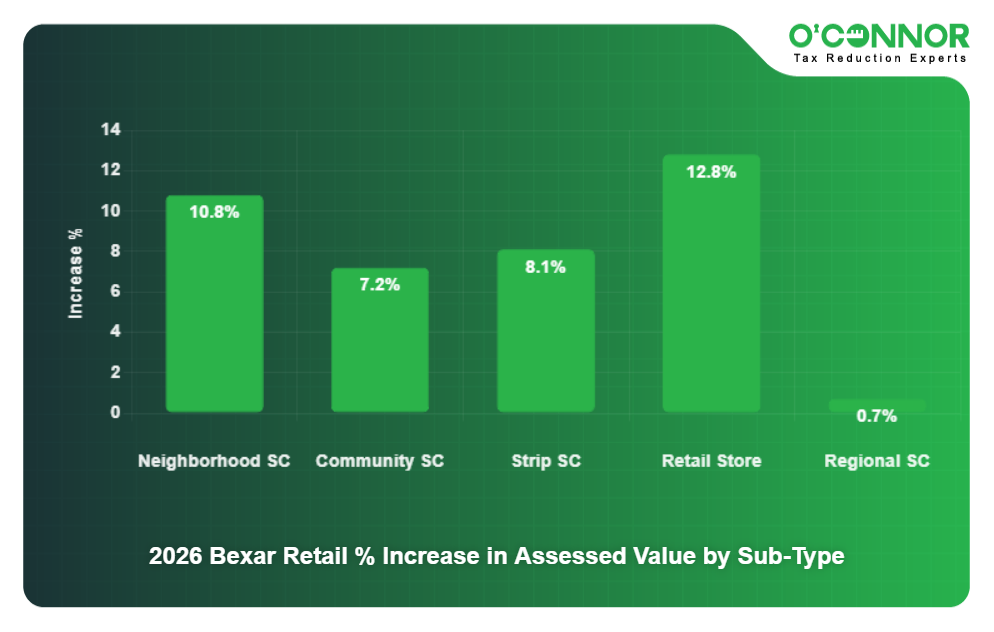
As is to be expected, the largest source of retail value was strip centers, which jumped 8.1% to $2.81 billion. They were followed by community shopping centers, which added 7.2% to total $2.19 billion. Neighborhood shopping centers skyrocketed 10.8% to $1.99 billion, while retail stores jumped 12.8% to $1.03 billion. Regional shopping centers saw an uptick of 0.7%, translating into a total of $814.52 million.
Warehouses Add 11.8% in Value
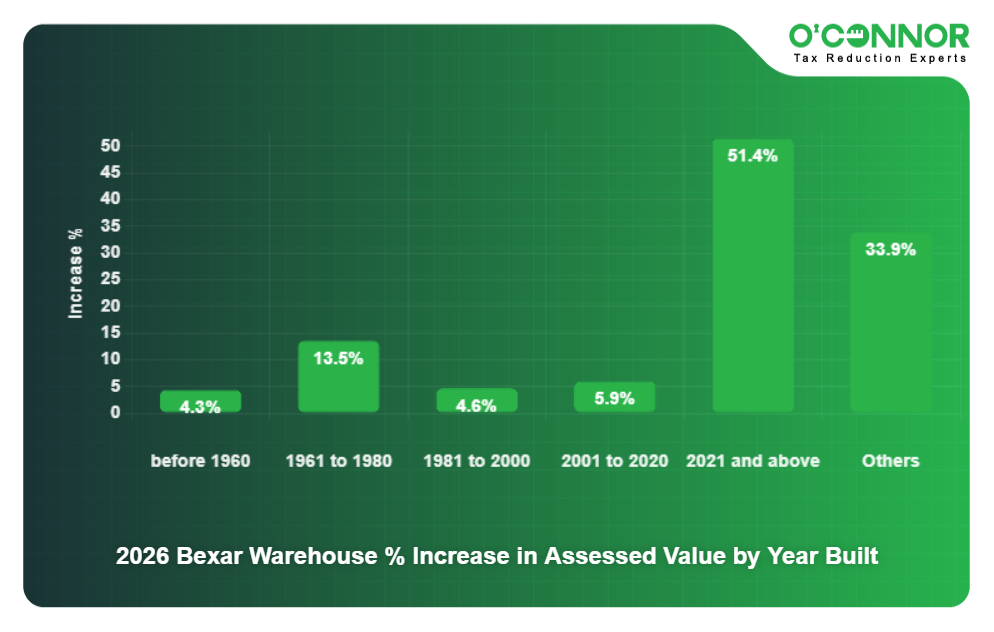
Though they grew by 11.8% in 2026, warehouses only accounted for $2.11 billion. This was low for a major urban area. 50% of all value was built between 2001 and 2020, which accounted for $1.06 billion following an increase of 5.9%. Those from 1981 to 2000 added 4.6% to account for $507.32 million. New construction surged by 51.4% and reached a total of $346.06 million.
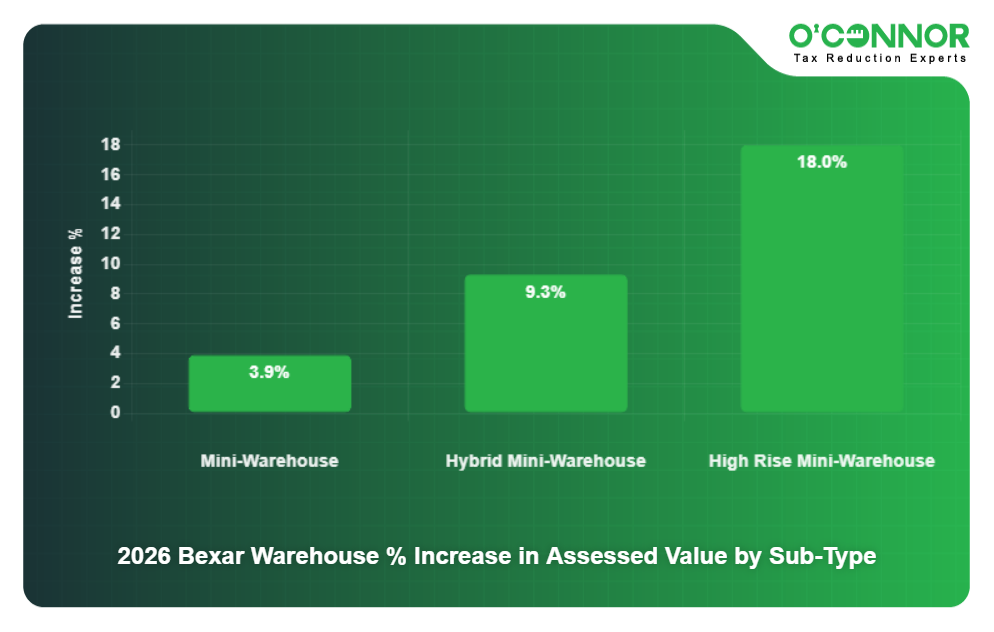
According to BCAD, there were three types of warehouses. Hybrid warehouses added 9.3% to total $1.02 billion, while high-rise warehouses skyrocketed 18% to $823.54 million. Fittingly, the smallest total was reserved for mini warehouses at $263.27 million, which followed an increase of 3.9%.
O’Connor Helps San Antonio Taxpayers with Appeals and Exemptions
While it might not have the giant swings of Travis County, Bexar is fertile ground for property tax protests. In 2024, 99% of informal appeals and 92% of formal protests ended in a reduction. These are some of the highest win rates in Texas, certainly for a major metropolitan area. In 2025, taxpayers managed to save around $61.6 billion in total value thanks to appeals. This showed that BCAD was open to granting reductions, but also that their appraisals were rife with errors. Despite this success, only around 26% of all properties were protested.
If you are looking to protest your home or business values, we at O’Connor are here to help. For over 50 years, we have been taking on appraisal districts across the nation. Based in Houston, we know Texas the best and have had great success over the years in San Antonio and the surrounding area. We even have a branch office in San Antonio to help our clients directly. While we focus on protests, we provide free help with homestead exemptions and offer cost segregation to businesses at competitive rates.
Anyone who joins us will get a client success consultant. Unlike other firms, we ensure that our clients always have a reliable person assigned to them, rather than a rotating cast of chatbots or customer service representatives. The consultant will guide you through the whole process and answer any questions about your case. We often send out concierge visits as well, where one of our experts will come directly to your home or business to help understand your appraisal, find hidden issues, and document evidence. There is no upfront cost to join, and you will only be charged from your savings if we are able to lower your property taxes.