
The Austin area and Travis County are the hottest housing markets in Texas, possibly the nation. As the premier suburb of Austin, Hays County has quickly shot up the charts as well, with taxes increasing over 300% in the past decade. While no one can question the economic realities of the housing market, it is easy to second-guess the unfair valuations made by the Hays County Central Appraisal District (Hays CAD). This has led to appeals rising almost as fast as values and taxes.
Hays County Homes Add 3.1% to Inflated Values
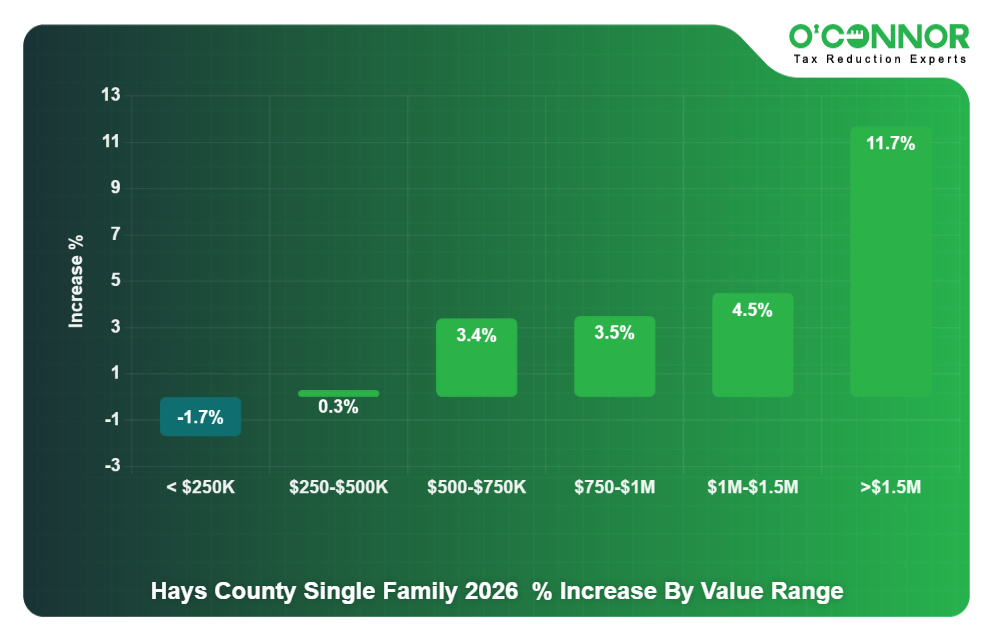
It is estimated that Hays added 3.1% in taxable housing value in 2026, growing from $42.83 billion to $44.14 billion. The largest block of value, homes worth between $250,000 and $500,000 saw a small reduction of .3%, though the total still managed to reach $15.59 billion. Homes worth under $250,000 also retreated 1.7% to $1.60 billion. All other types saw strong increases, with those over $1.5 million jumping 11.7% to $6.15 billion. Homes worth between $1 million and $1.5 million added 4.5% in taxable value, which resulted in a final sum of $5.47 billion.
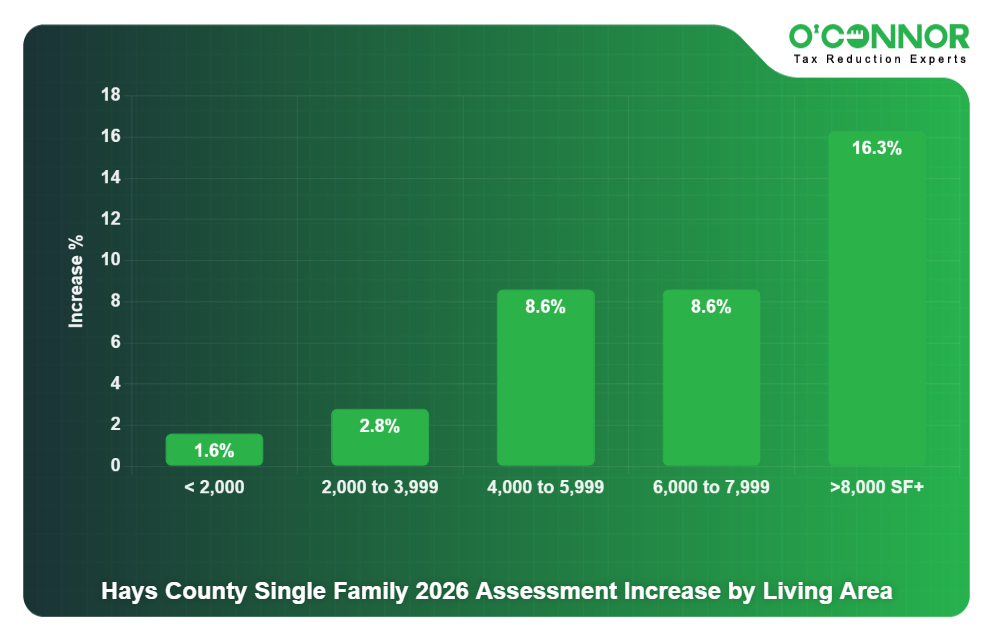
Despite high-dollar properties being the norm, Hays County was far from being awash in mansions. Growing by 1.6%, homes under 2,000 square feet reached $14.70 billion in total value. The largest total was for homes between 2,000 and 3,999 square feet, which grew 2.8% to $24.80 billion. Homes measuring between 4,000 and 7,999 square feet grew 8.6%. Though the smallest category, massive residences still added 16.3%, achieving a combined value of $527.79 million.
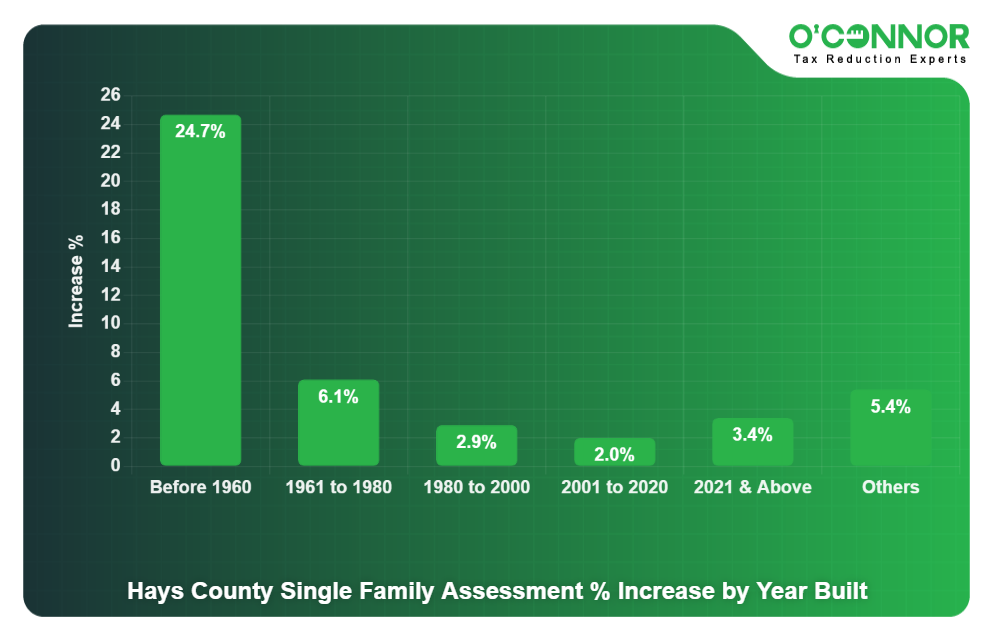
Texas, in general, saw a large building boom between 2001 and 2020, and Hays was no exception. 51% of all residential value was constructed in this timeframe, roughly totaling $22.3 billion after an increase of 2%. 20% of the value was built within the past five years, resulting in a combined $8.89 billion. While most value was from recent construction, the highest-growing segment was built before 1950, growing 24.7% to $755.74 million. 19% of home value was constructed between 1981 and 2000, which equaled $8.22 billion after adding 2.9%. This generally shows that recent construction has fueled the meteoric rise of Hays County.
Hays County Houses Valued above/below Market Value
While the majority of residential categories grew in 2026, this might not be simply due to natural market factors. It is estimated that about 59% of homes in the area are currently overassessed, while 41% are undervalued. This opens things up for property tax appeals, as overvaluation is one of the top reasons to protest. Unequal appraisal could also be a useful reason to protest and could also save a taxpayer significantly.
Housing Market Hotter than Hays CAD Believes?
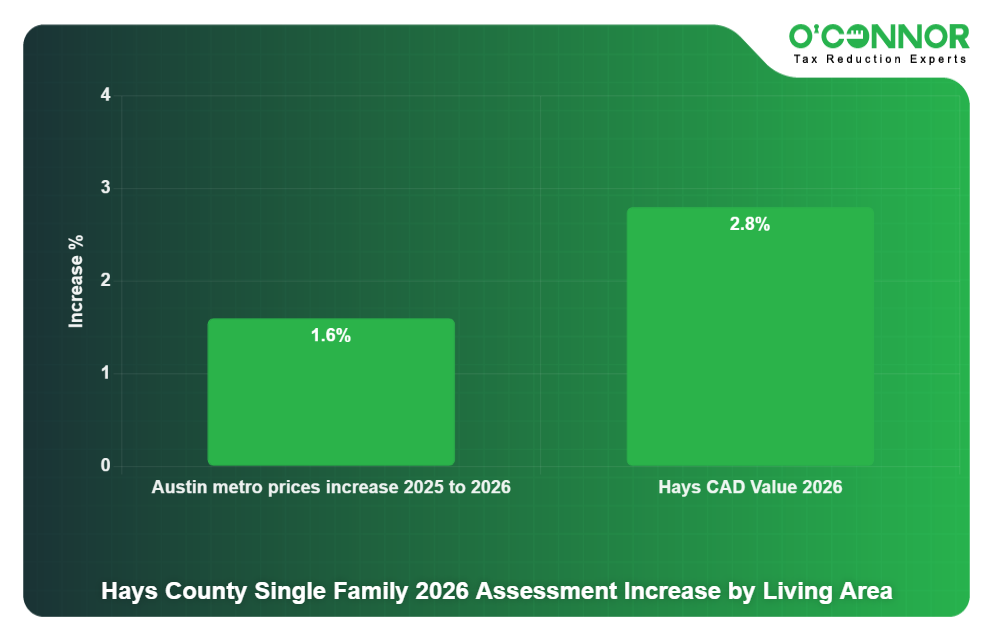
While overassessment may be rampant for many homeowners, Hays CAD might not understand just how high the market for homes currently is. It is common for assessed values to lag behind the market, so this is not unique to the Austin area. The Austin Board of Realtors estimated that housing prices increased by 6% in real market value, while Hays CAD believed it grew 3.1%. This could mean that values will increase in the near future when it comes to taxes, but could provide fertile ground to target unequal appraisal in the meantime.
Hays County Commercial Properties Soar 21.9% in Just One Year
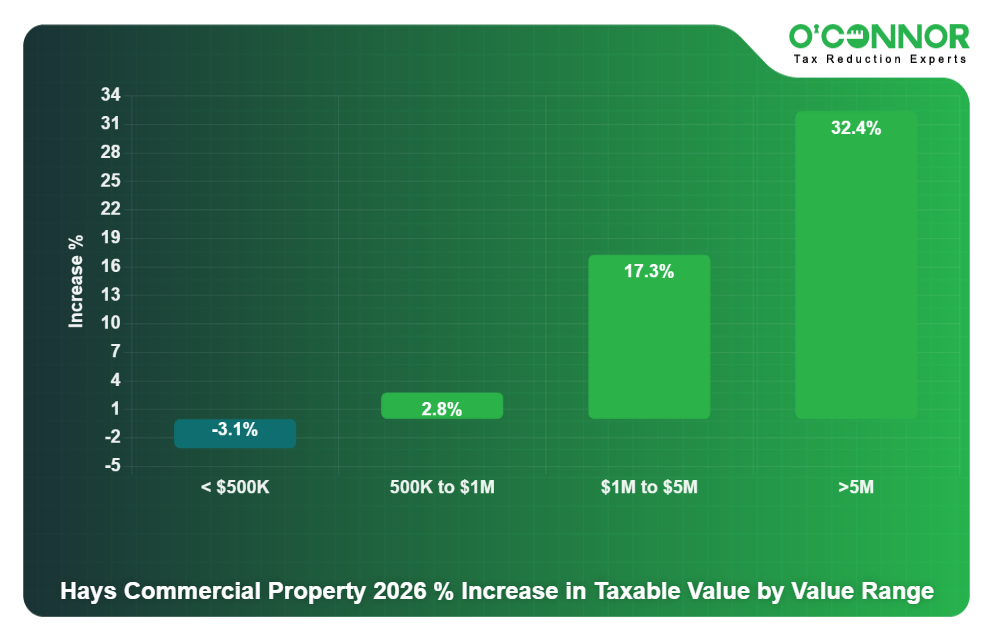
While residential property grew relatively slowly in 2026, the same cannot be said for businesses. Overall, commercial real estate added 21.9% in value, reaching an overall number of $11.04 billion. This was driven by a 32.4% increase for the largest businesses, achieving a new total of $5.64 billion. Businesses worth between $1 million and $5 million increased 17.3% to $4.07 billion. It is common in Texas for large businesses to control most of the value. Small businesses lost around 3.1% in value, though they totaled only $481.96 million.
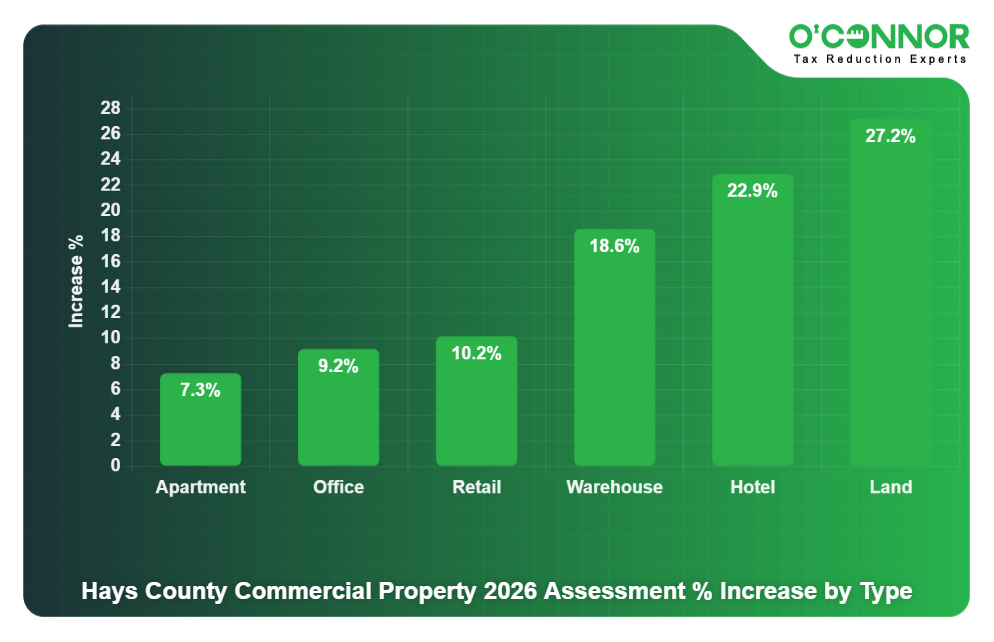
Demonstrating Hays County’s untapped potential, the largest source of commercial value was raw land, which reached $7.26 billion after a large jump of 27.2%. This was followed by $1.23 billion for warehouses, which grew 18.6%. Despite growing 10.2%, retail spaces reached $860.97 million, while hotels soared to $281.37 million after a large increase of 22.9%. Offices added 9.2%, while apartments managed to reach $669.62 million, thanks to an increase of 7.3%.
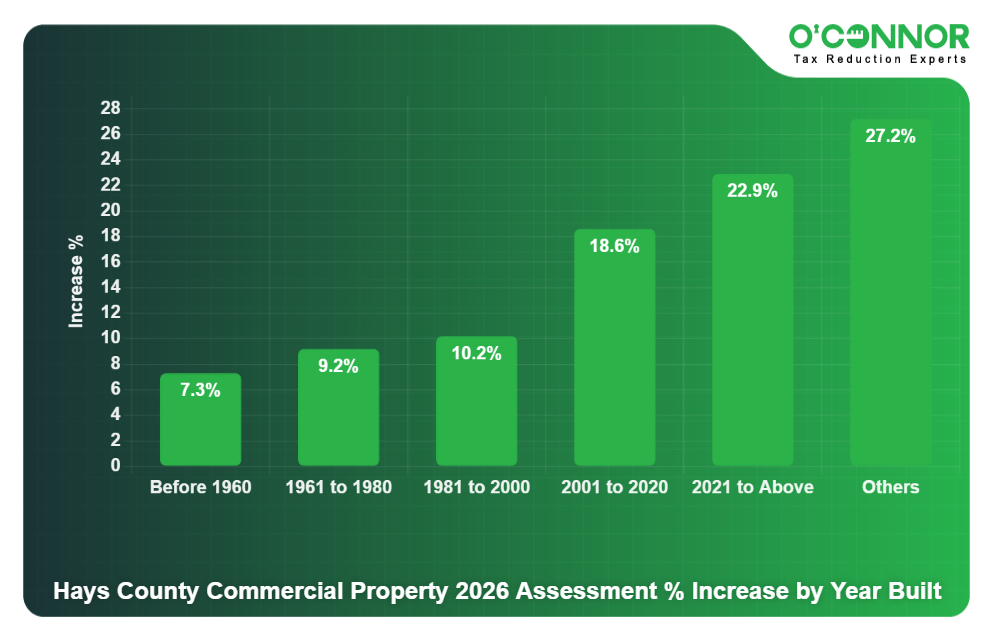
Like residential real estate, commercial value is generally weighted toward recent construction. Adding 17.8% in value in 2026, recent construction managed to reach $66.11 million, or 6% of the total. 15% of all value was built from 2001 to 2020, which equaled $2.21 billion after a spike of 12%. The largest growth rate was 26.7% for raw land, which made up 68% of all value. Older construction got in on the act with 11.5% increases for businesses built from 1981 to 2000 and those from 2001 to 2020. Those from before 1950 grew 13.2% to $27.64 million.
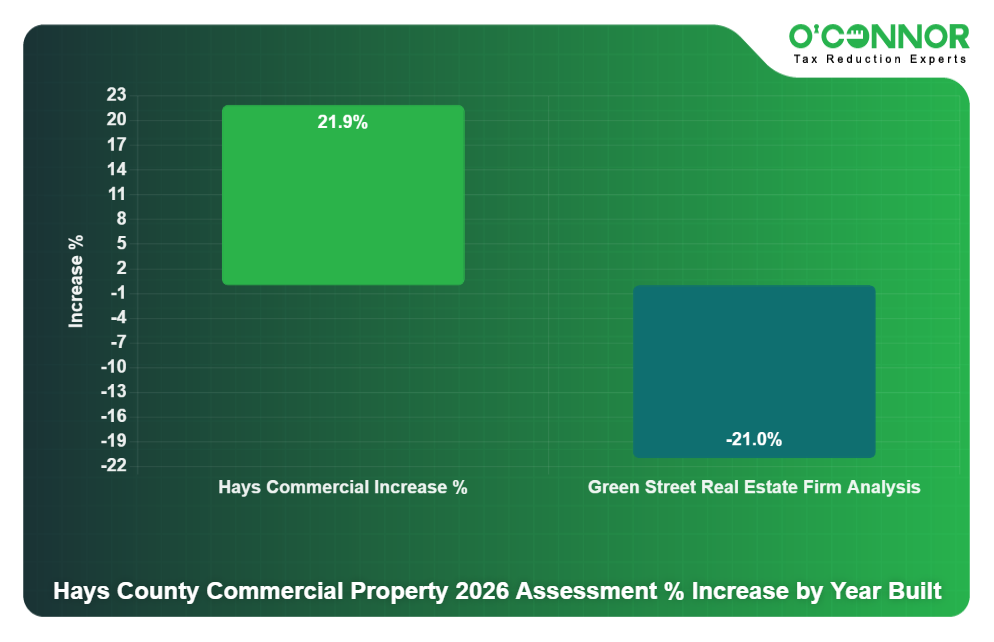
While all property across Hays County is clearly gaining in value, there is some evidence to show that it is not to the extent that Hays CAD would claim. Real estate firm Green Street studied commercial properties all across the nation and determined that real value actually fell by 21%, compared to the gain of 21.9% seen in Hays County. While the Green Street study is for the entire nation, it does cause some consideration when it comes to possible business values, and makes it clear that appeals could be called for to find out the truth.
Apartments Add 7.3%
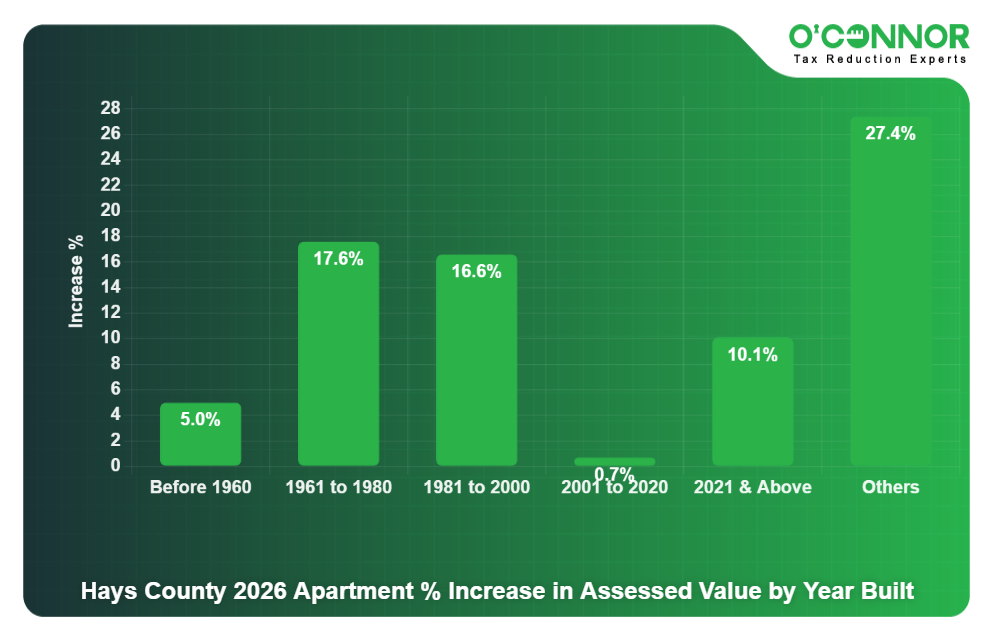
In most urban counties, apartments represent the largest type of commercial real estate. While this was not the case in Hays County, they still managed to increase 7.3% to $669.62 million. 45% of all multifamily housing value was built between 2001 and 2020 in the construction boom, a total of $302.93 million. $242.36 million, or 30% of the total, is thanks to recent construction, which added 10.1% more in 2026. Though they made up only fractions of the whole, those built from 1981 to 2000 and those from 1961 to 1980 increased by 16.6% and 17.6% respectively.
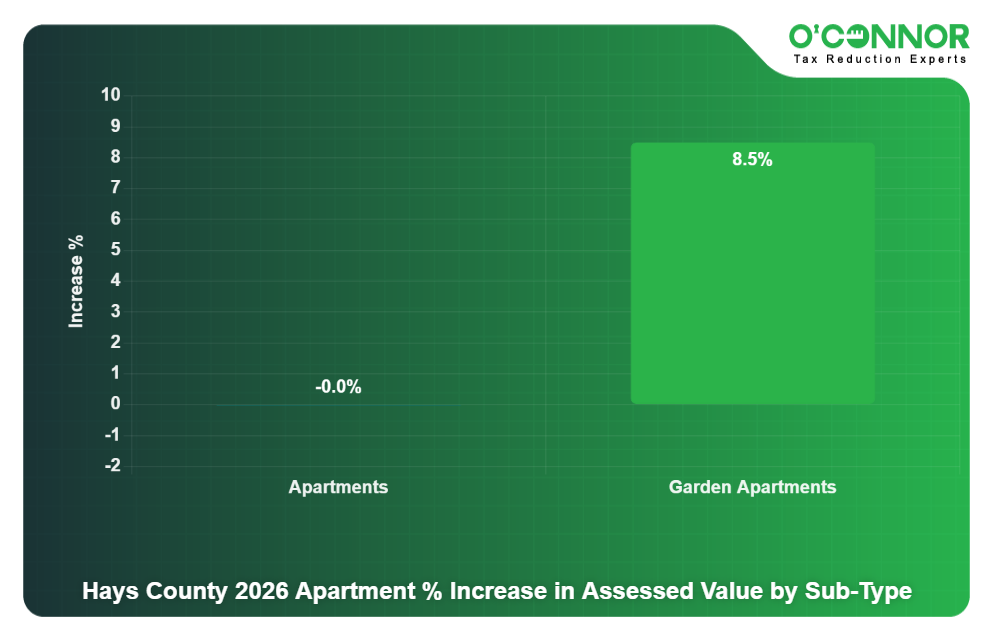
Hays CAD divided all apartments into only two categories. Garden apartments were the larger category and grew 8.5% to $581.70 million. Generic apartments were much smaller at $87.92 million and saw no real change.
Offices Grow by 9.2%
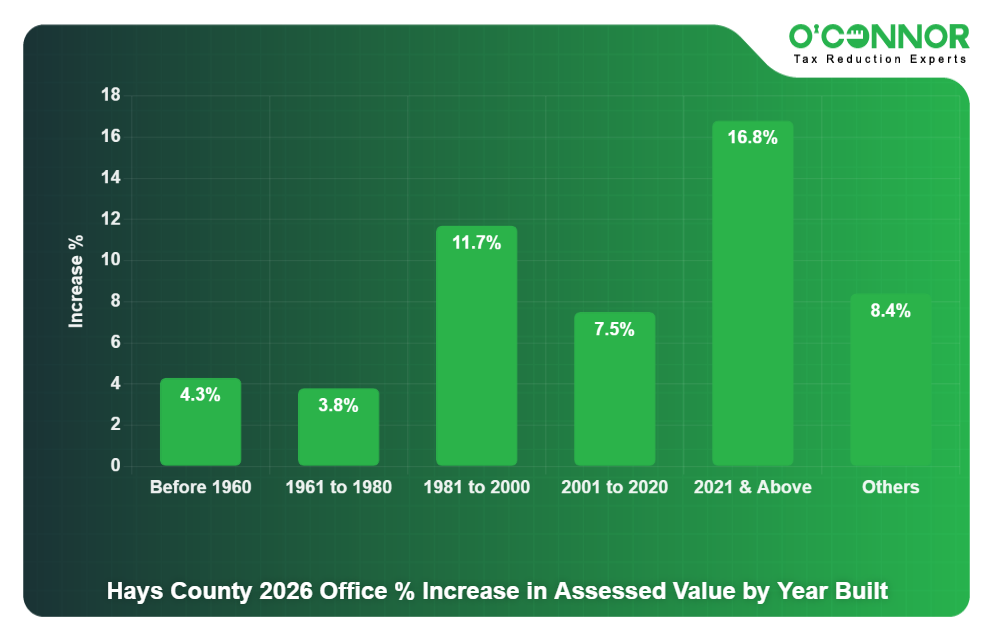
Offices continue to bounce back after the pandemic and saw an increase of 9.2% in 2026. This took the total to new heights at $639.64 million. Like most construction, the majority of offices were built between 2001 and 2020, with 58% of all value being built in this timeframe. This jumped 7.5% to $374.70 million. Spiking by 16.8%, newly built offices accounted for $78.55 million. Offices did lean older than other construction, with 17% of all value being built from 1981 to 2000, a final sum of $106.55 million. Even these older offices saw a jump of 11.7%.
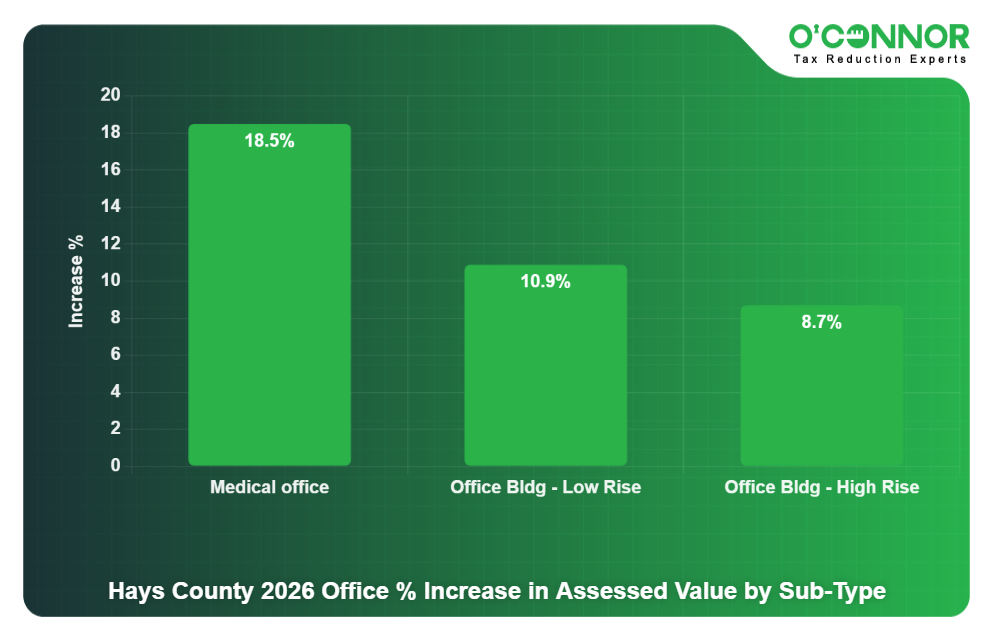
For measurement purposes, offices were divided into three categories. High-rise offices were the largest with $492.51 million after an increase of 8.7%. Low-rise buildings came in second with $143.23 million. Medical offices saw the biggest gain at 18.5%, but only combined for $3.91 million.
Retail Spaces Add Over 10%
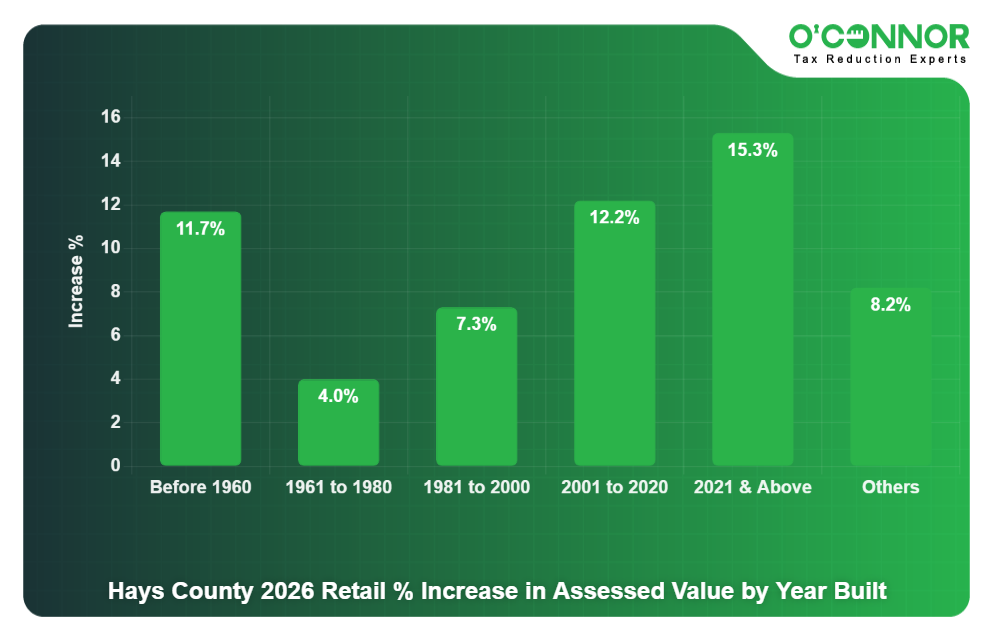
Like offices, retail has had something of a rebound in the past few years. 51% of all value was built between 2001 and 2020, and this even increased rapidly by 12.2% to $493.40 million. Adding 7.3%, those built from 1981 to 2000 contributed 33% or $321.17 million to the whole. New construction added 15.3%, reaching $48.38 million. In a continuing trend, older construction saw strong growth, but this only equaled a fraction of the whole.
Warehouses Jump 18.6%
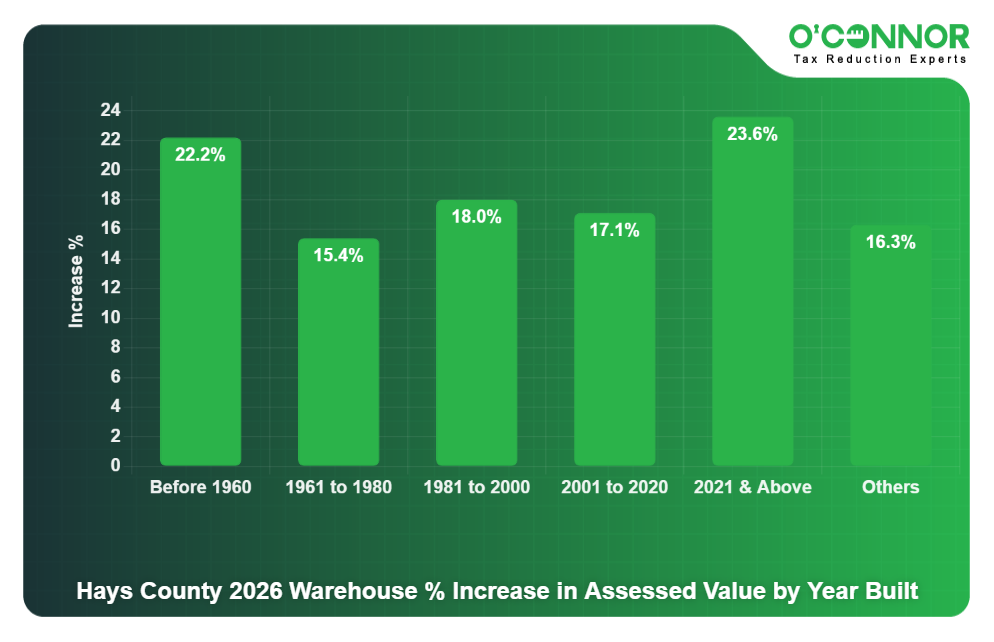
Economies can always count on warehouses, and Hays County saw these humble structures generate the most value in the county outside of raw land. Soaring 18.6% in 2026 alone, warehouses accounted for $1.23 billion. Keeping the trend going, 58% of all value was built from 2001 to 2020, with that timeframe adding 17.1% in 2026. New construction increased 23.6%, which resulted in 22% of the value, or $214.40 million. Adding 18%, those built from 1981 to 2000 were responsible for $174.57 million. While they grew significantly, older warehouses only accounted for 2% of the whole.
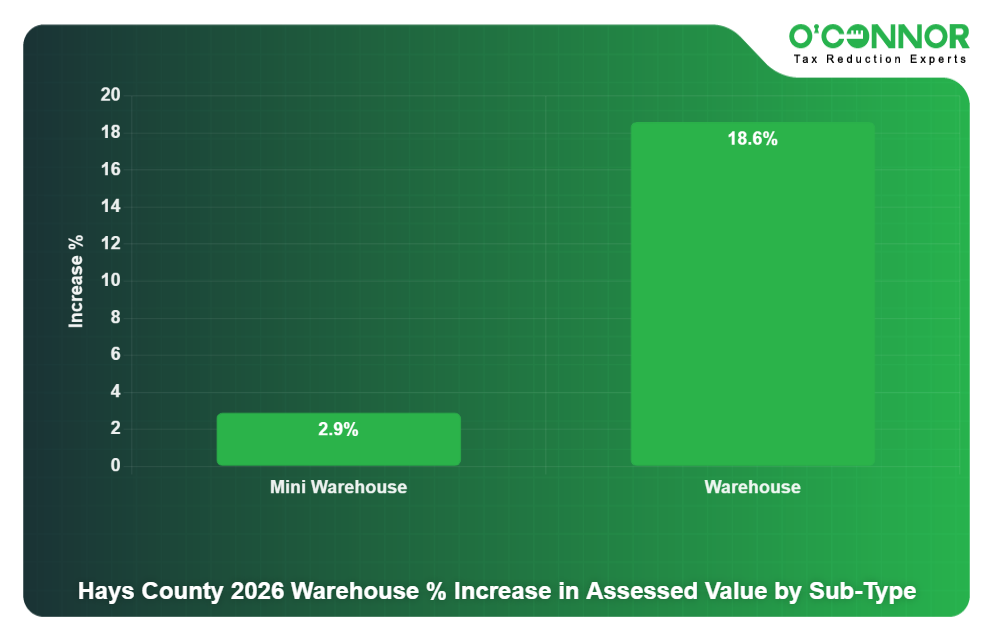
Hays CAD only divided warehouses into two categories for measurement. Generic warehouses added 18.6% and totaled $1.23 billion. Mini warehouses only added 2.9%, reaching $334,300.
Hays County Continues to See a Real Estate Surge
The property value of Hays County has increased by over 400% in the past decade and shows no signs of slowing down. While the previous jumps have generally been predicated on homes, commercial real estate is becoming more important every year, with 2026 arguably being the most important yet. Thanks to the growing value of Travis County and Austin, more people and companies will be flocking to Hays in the upcoming years, which is sure to push values and taxes even higher.
Texans are fighting back with property tax appeals like never before. The Austin area is one of the most protested in Texas, and taxpayers have seen real gains thanks to taking on Hays CAD and other appraisal districts in the area. Enroll with O’Connor and add your name to this list, giving you the best possible chance at a tax reduction. Hays CAD will continue to assess inflated appraisals as long as it is able to, and government entities will keep pushing for higher tax rates. Appeals and exemptions are the only two options that taxpayers have to stem the tide.
There is no cost to join us, and you will never be handed an upfront or hidden fee. Every taxpayer who joins gets a client success consultant, who acts as your single point of contact, giving you a person to communicate with instead of a bot or an inbox. Many clients can also book a concierge visit, where one of our team members will come out and examine your property for any issues that can help with an appeal. There is no risk to challenging your taxes, as they cannot be increased due to an appeal. With O’Connor, you will only be charged a portion of your winnings if we can lower your taxes.