


Fort Bend County has been the premier Houston suburb for decades and continues to grow in prominence, even with competition from the likes of Montgomery County. For over a decade, Fort Bend has had the highest property taxes in Texas, and it still ranks in the top five every year. This has also led to the people of the county appealing their taxes like no other area in Texas, which has helped tip the scales in favor of the taxpayer. In 2026, the Fort Bend Central Appraisal District (FBCAD) handed out more increases, which the people of the county will have to fight back down to reasonable levels.
Fort Bend Residential Property Adds 4.5%
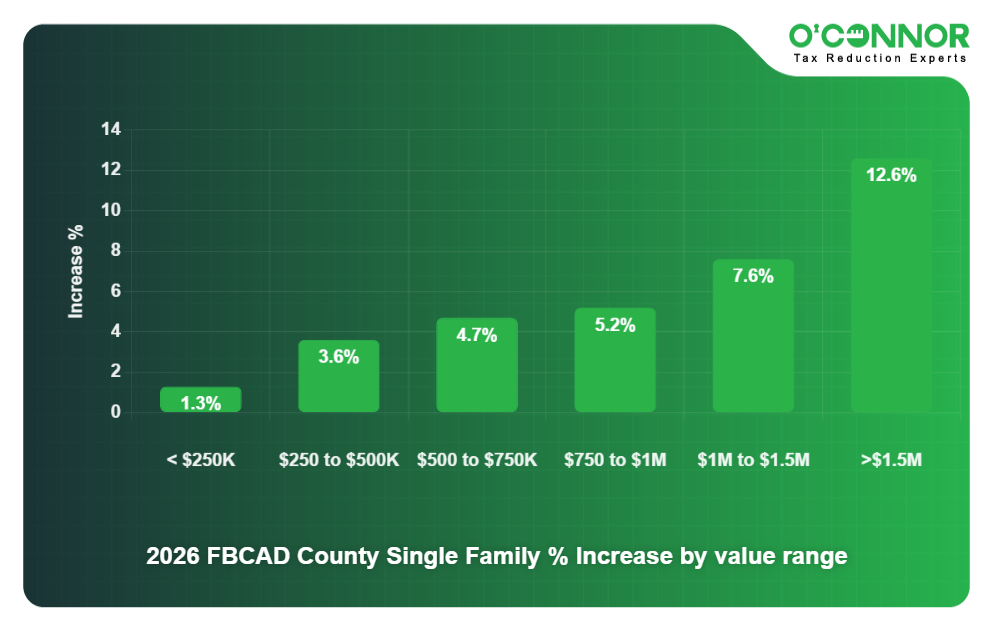
Growing higher than inflation, homes added 4.5% in taxable value in 2026, bringing the total to $127.39 billion. The biggest source of value was homes worth between $250,000 and $500,000, which reached $56.42 billion after growing by 3.6%. Surging 4.7%, homes worth between $500,000 and $750,000 were in second place with $35.48 billion. Residences valued at $750,000 to $1 million were in third place with $13.80 billion, increasing by 5.2%. Though they were the least valuable of all categories, homes worth over $1.5 million grew by an astounding 12.6%
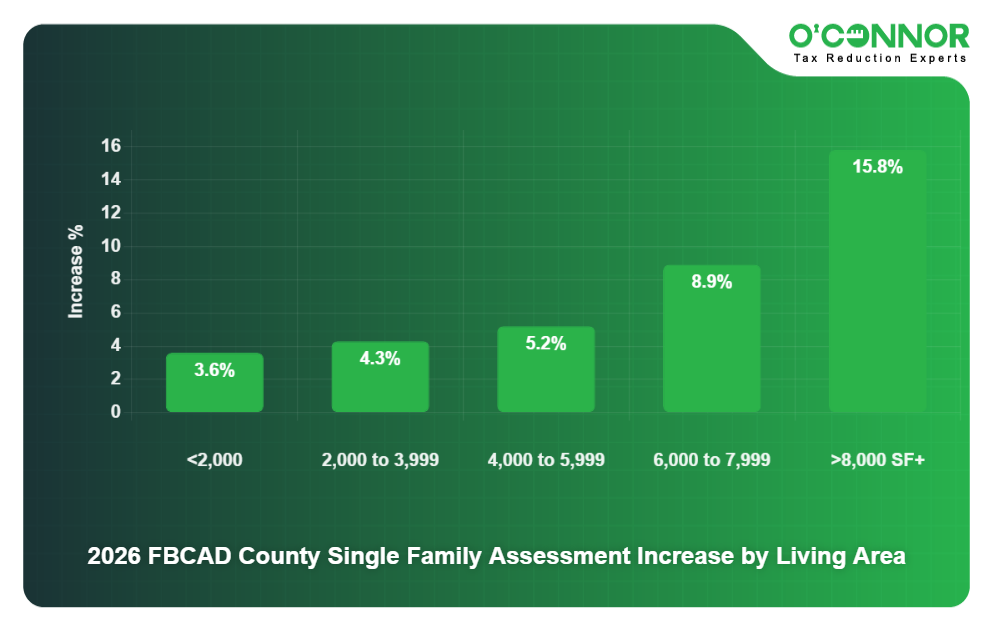
Despite value being concentrated on expensive houses, most of these were modest homes, not mansions. This shows just how valuable real estate in Fort Bend has become. With a combined sum of $80.50 billion, residences between 2,000 and 3,999 square feet were in the No. 1 spot, and also increased by 4.3%. In second place, with $22.47 billion, were homes measured between 4,000 and 5,999 square feet. The smallest homes were in third place and grew by 3.6% to total $20.19 billion. True mansions saw a strong increase of 15.8% and totaled $1.68 billion.
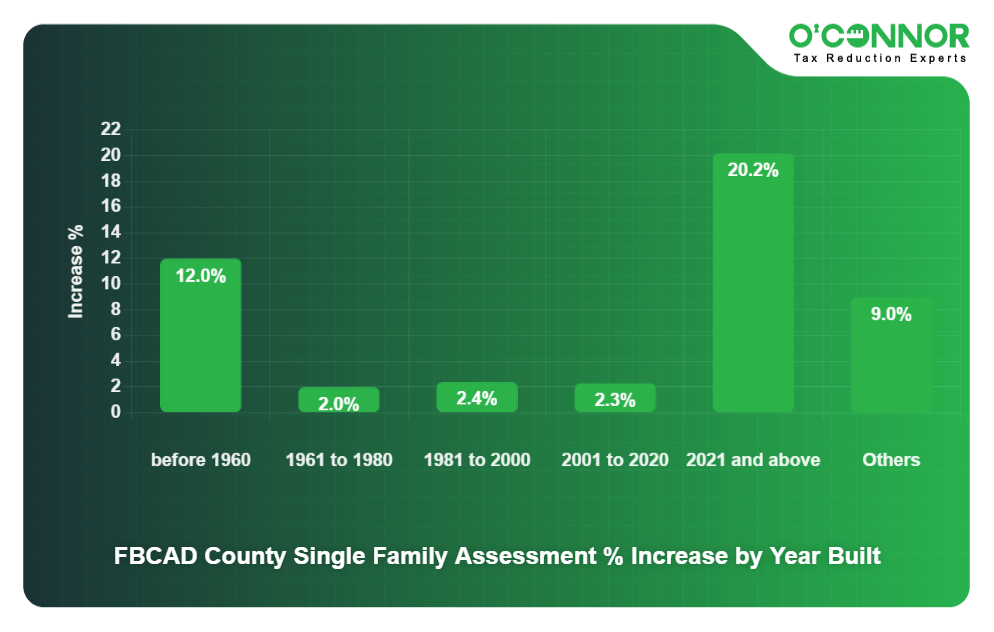
Across Texas, most value was built in the construction boom from 2001 to 2020, and Fort Bend is no exception. Over 57%, or $73.19 billion, was built in this timeframe. These residences also added 2.3%. New construction has also been booming, and after shooting up 20.2%, new homes accounted for $17.24 billion. After jumping 2.4%, homes built from 1981 to 2000 totaled $27.80 billion, coming in second place. While they all added significant value, the remaining pieces of residential real estate only combined for 7% of all value.
Over Half of Homes are Overvalued
FBCAD County Houses Valued above/below Market Value
On top of high prices, FBCAD is generally believed to be quite overzealous with appraisals. This is why property tax appeals are so rampant across the county. This seemed to be proven correct, as 2026 analysis showed that an estimated 57% of homes were overvalued by FBCAD. This shows that even more appeals should be called for and that residents should do so annually just to protect themselves.
Houston-Area Homes Overassessed
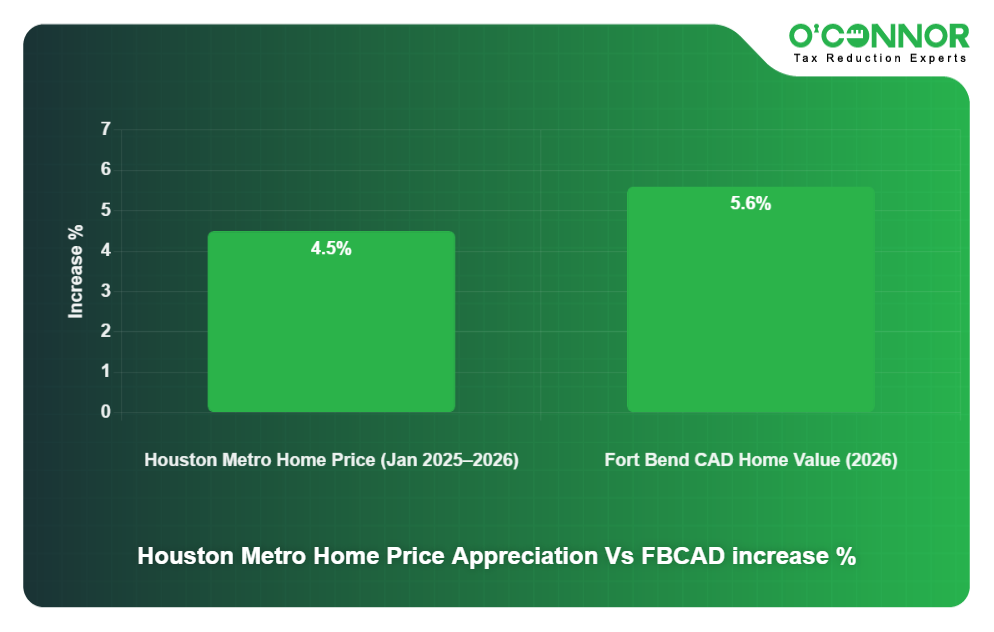
A group of realtors and other real estate professionals studied the sales records of homes in Houston and the surrounding area. They came to the conclusion that homes depreciated by an estimated 2.6%. In contrast, FBCAD said that homes added 4.5% in value. While the truth could certainly be somewhere in the middle, it is clear that all appraisals should be reevaluated through appeal, just to be sure.
Fort Bend Businesses Spike by Over 15%
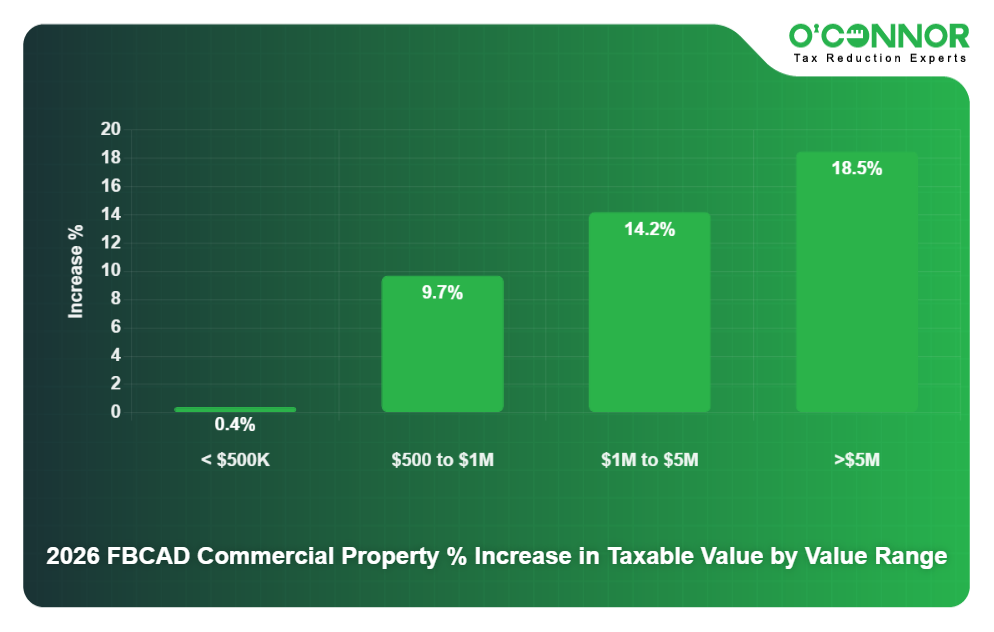
While Fort Bend has a reputation as a residential suburb, it has seen growing economic activity in the past decade and is becoming a commercial powerhouse in its own right. 2026 saw this continue as over 15.4% more commercial value was added, making a new total of $21.69 billion. Most of the growth and overall value came from businesses worth over $5 million, which is typical in Texas. These massive enterprises grew by 18.5% and reached $13.55 billion. Adding 14.2% to their value, businesses worth between $1 million and $5 million totaled $5.30 billion. The other two categories of business combined for less than $3 billion in total, but those worth between $500,000 and $1 million managed to jump 9.7%.
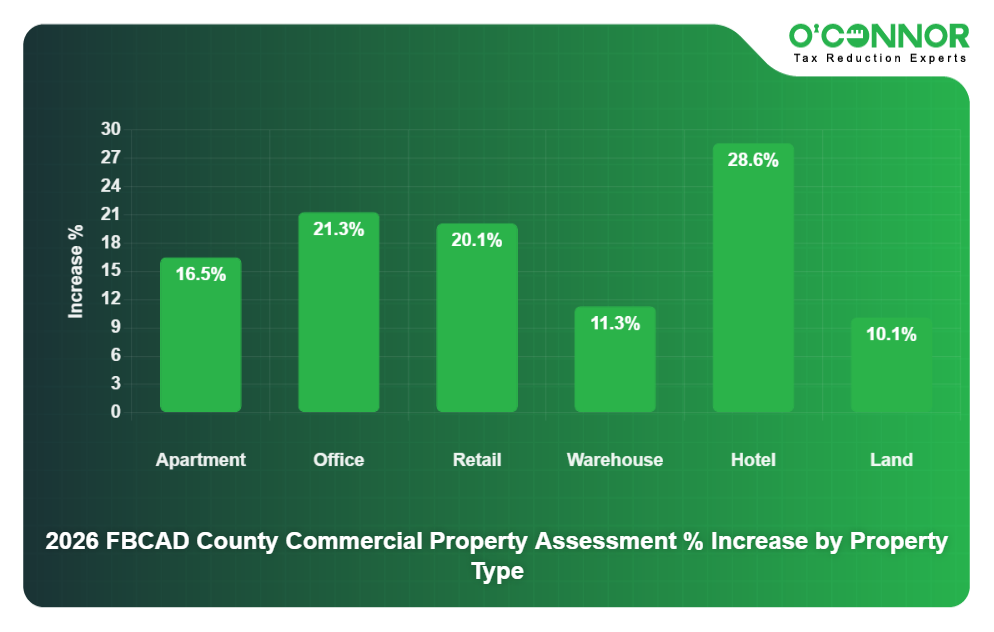
When broken down by type, the various commercial properties of the county were largely even in totals, with there not being one dominant business model. The largest total was held by raw land at $6.82 billion. Apartments spiked by 16.5% to total $5.01 billion. Offices added an astounding 21.3%, while retail soared 20.1%. These totaled $2.89 billion and $4.26 billion respectively. Warehouses tallied $2.22 billion after an increase of 11.3%. The small category, hotels, skyrocketed by 28.6%.
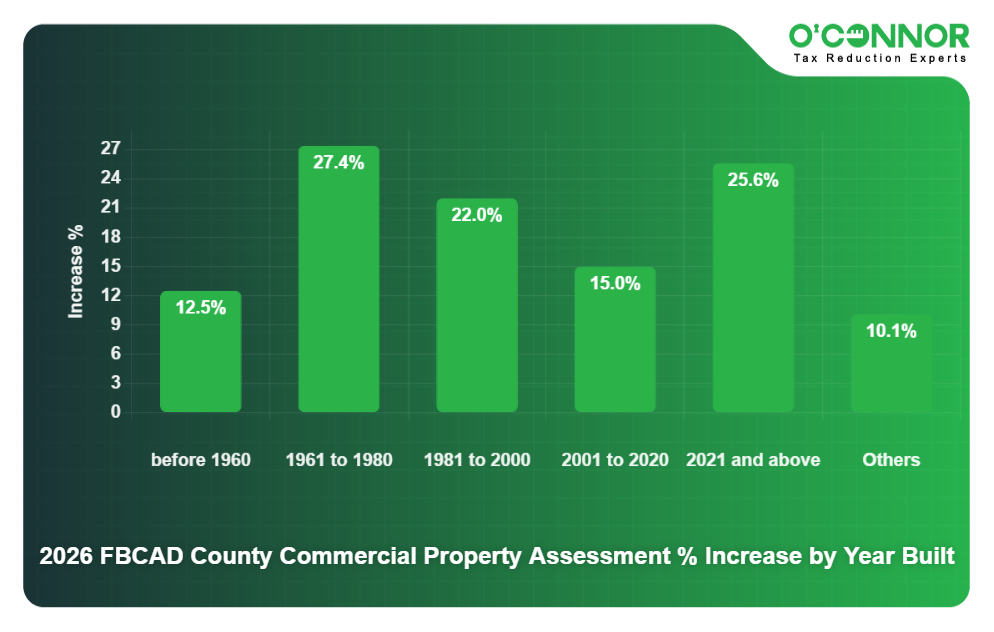
Like residential real estate, commercial property saw most of its value constructed from 2001 to 2020. Over $9.41 billion was built in this timeframe, which was achieved after a strong jump of 15%. In second place, buildings from 1981 to 2000 grew by 22%, totaling $3.26 billion. New construction was once again a big factor, soaring by 25.6% to $1.61 billion. The largest reservoir of value was in raw land, while older buildings only managed to encompass around 2% of value. This shows how much Fort Bend County has developed in just a decade.
Fort Bend Business Real Estate Exceeds the National Average
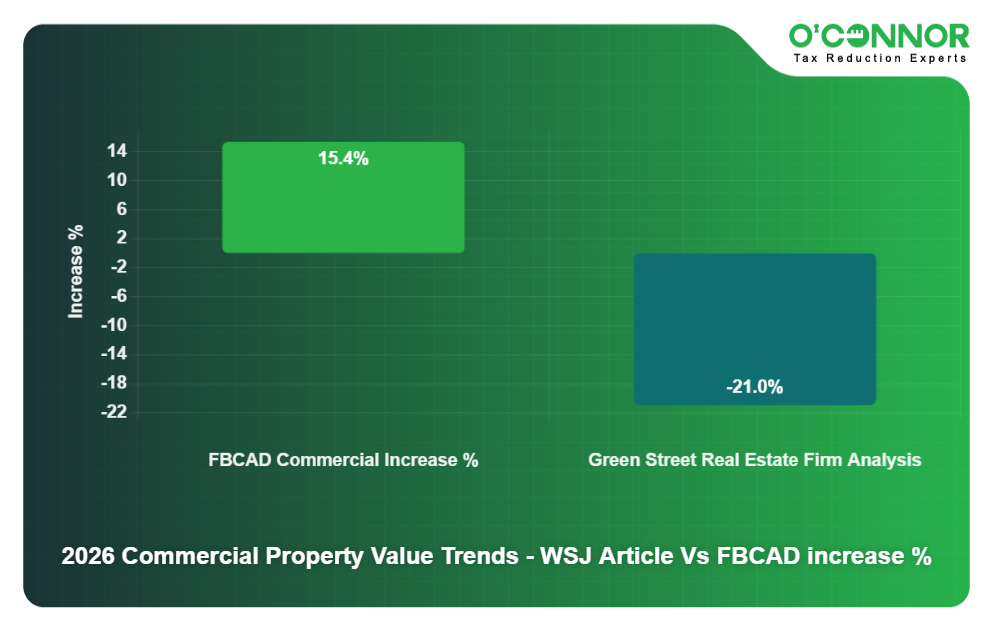
While the growth of Fort Bend’s economy cannot be denied, it is possible that it is being overvalued by FBCAD, as homes are. In a nationwide study of commercial property, Green Street discovered that the overall value of business property dropped by 21%. This is especially true for offices. On the flipside, Fort Bend added 15.4%. While Texas is doing better than most other states when it comes to business, the FBCAD numbers could still be overcooked. This should encourage business owners to appeal annually, though most do so already.
Apartments Continue to be King
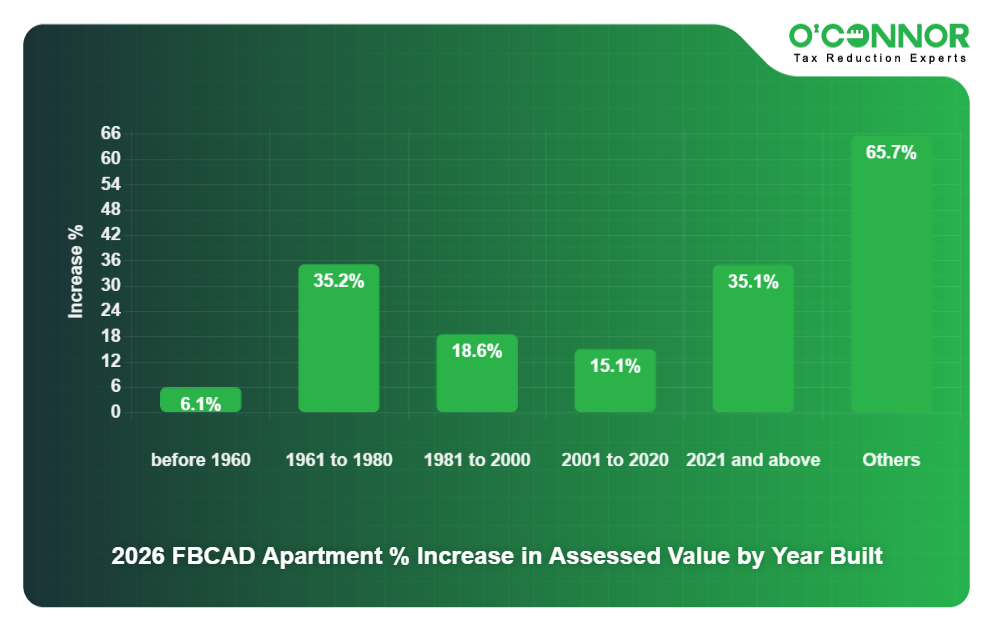
In most urban Texas environments, the top business real estate is apartments. With its suburban nature, Fort Bend continues this trend, and multifamily housing makes up the largest value enclave outside of raw land. Of the $5.01 billion total, a staggering 76% of value was built between 2001 and 2020. This was enhanced even more by a growth rate of 15.1%. Apartments built from 1981 to 2000 were in a very distant second place with $964.42 million, though they added 18.6%. New construction spiked 65.7%, though this only translated into a total of $6.59 million.
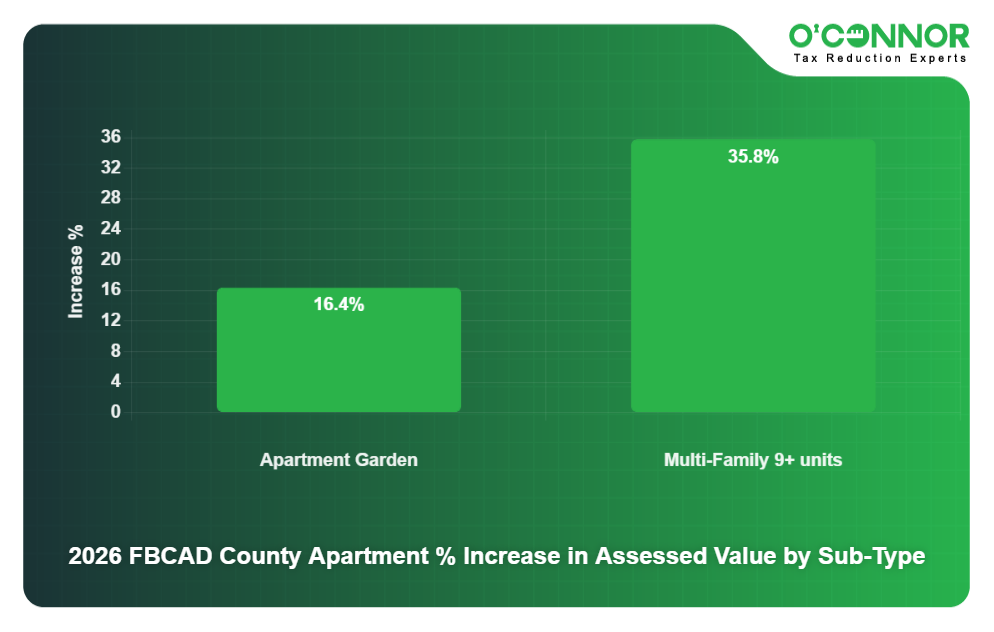
FBCAD does not provide much detail, only breaking multifamily housing into two categories. Garden apartments totaled $4.97 billion, after increasing by 16.4%. Multifamily units did increase by 35.8%, though they totaled only $34.06 million.
Fort Bend Offices Rebound by 21.3%
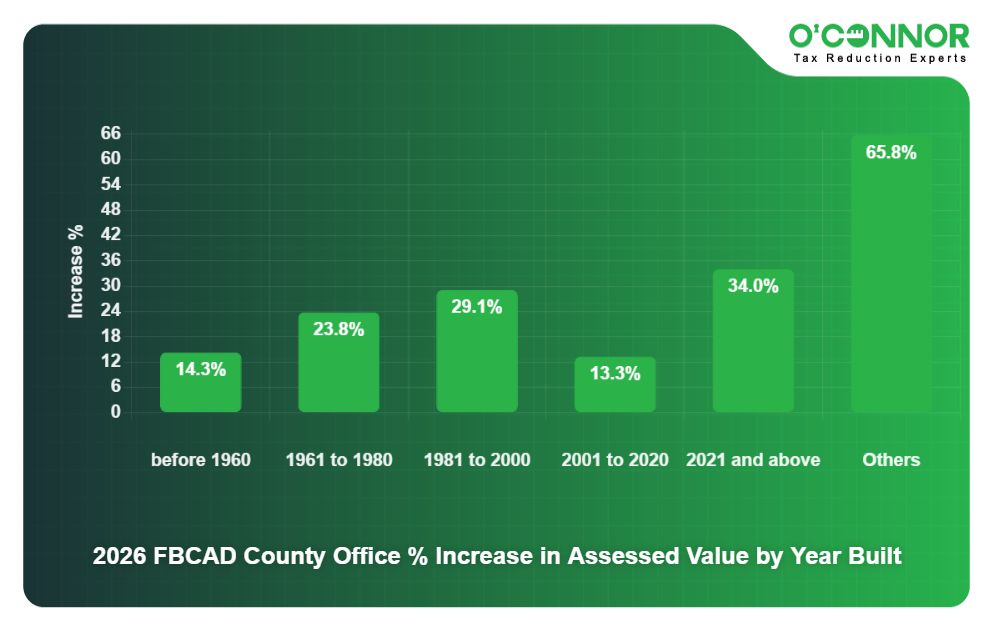
While office vacancies are starting to fill up, most counties have still seen office values hover on the low side. Not the case in Fort Bend, as office value soared by 21.3% in 2026, which meant a final sum of $2.89 billion. $1.42 billion came from offices built from 2001 to 2020, which also added 13.3%. New construction jumped 34% to $567.27 million, which now accounts for 20% of all value. Those from 1981 to 2000 increased 29.1% to $759.74 million. Raw land and the other two timeframes accounted for roughly 5% of the remaining value, though all landed significant increases.
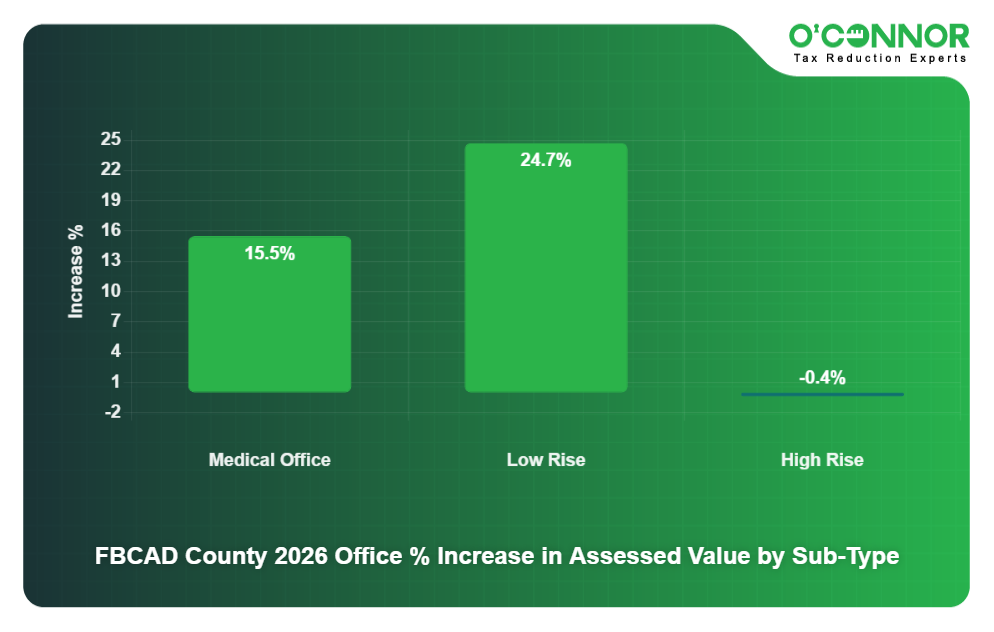
Increasing by 15.9%, low-rise offices tipped the scales at $1.99 billion. Medical offices managed to reach $852.24 million by adding 15.5%. High-rise offices lost value by 0.4%, dropping to $55.89 million.
Fort Bend Retail Jumps 20.1%
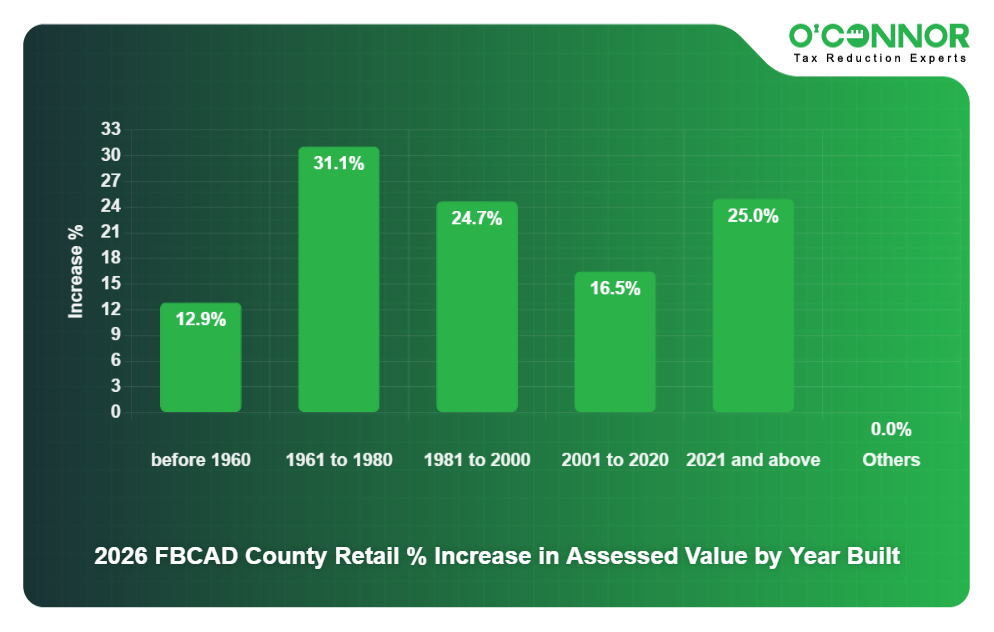
Retail spaces have also made strides since the pandemic, and 2026 saw a significant value spike of 20.1%, which ended up with a final tally of $4.26 billion. Retail businesses followed a similar pattern to most other types when it comes to age of construction, with the most value being built from 2001 to 2020. These stores accounted for $2.36 billion after growing by 16.5%. In second place, those constructed from 1981 to 2000 added 24.7% to the total of $1.18 billion. New construction grew the most at 25%, which meant a final total of $529.14 million. All other timeframes were responsible for around 5% of the total.
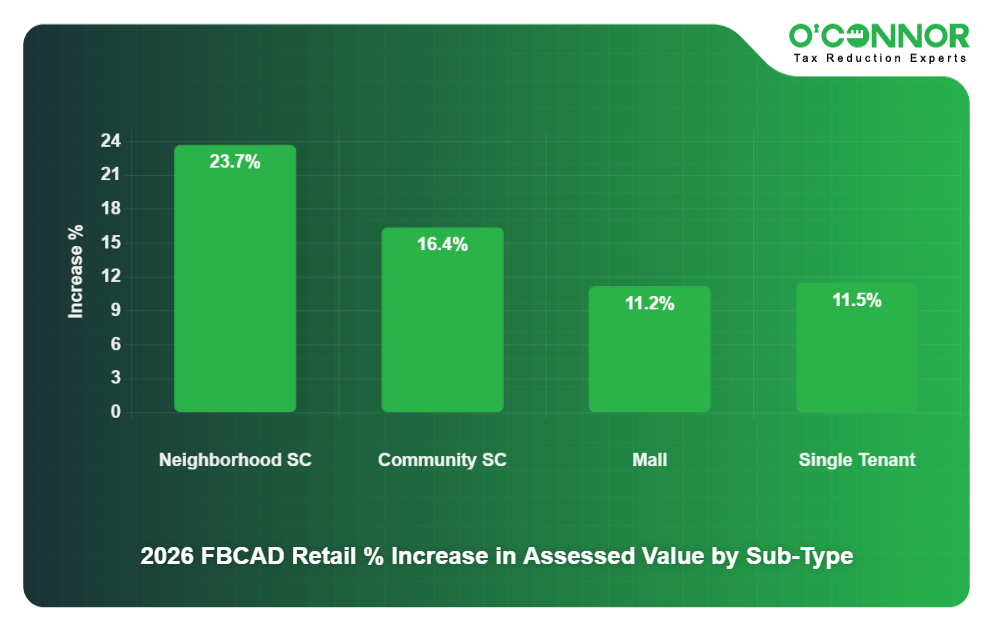
Adding 23.7% in value, neighborhood shopping centers totaled $2.82 billion. Community shopping centers added 16.4% and accounted for $739.85 million. Malls added 11.2% of value, while single-tenant stores surged 11.5%. They totaled $364.81 million and $342.02 million respectively.
Storage Facilities Expand by 11.3%
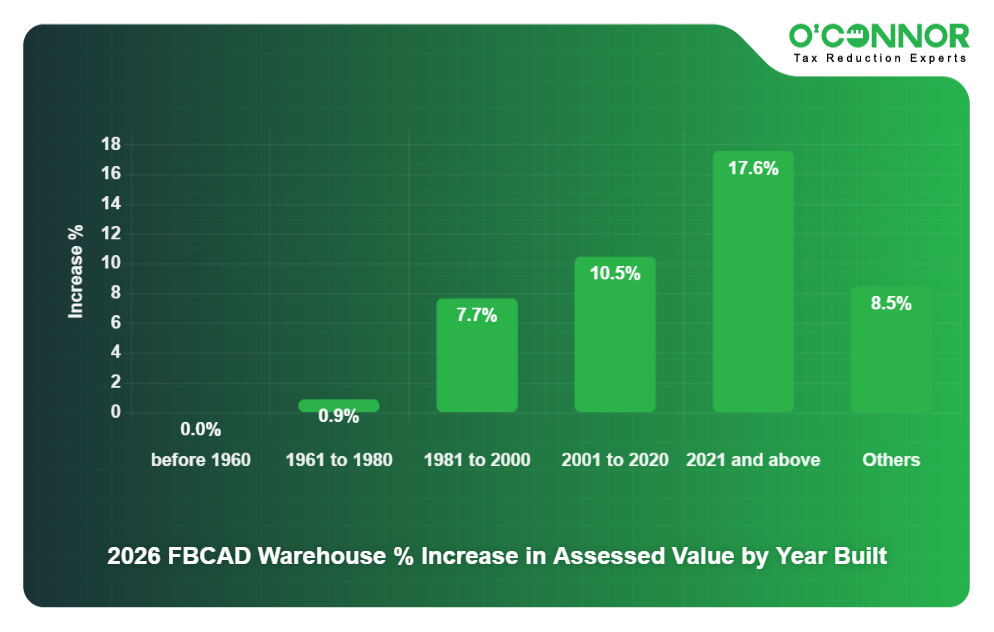
Totaling $2.22 billion, warehouses were a small but important aspect of the economy. Like all other pieces of real estate, the largest chunk of value came from those built from 2001 to 2020, which totaled $1.43 billion after increasing by 10.5%. The pattern was slightly broken, as new construction ended up in second place with $476.76 million following an impressive jump of 17.6%. $269.23 million in value came from those warehouses built from 1981 to 2000. The remaining warehouses only contributed 2% of the total value.
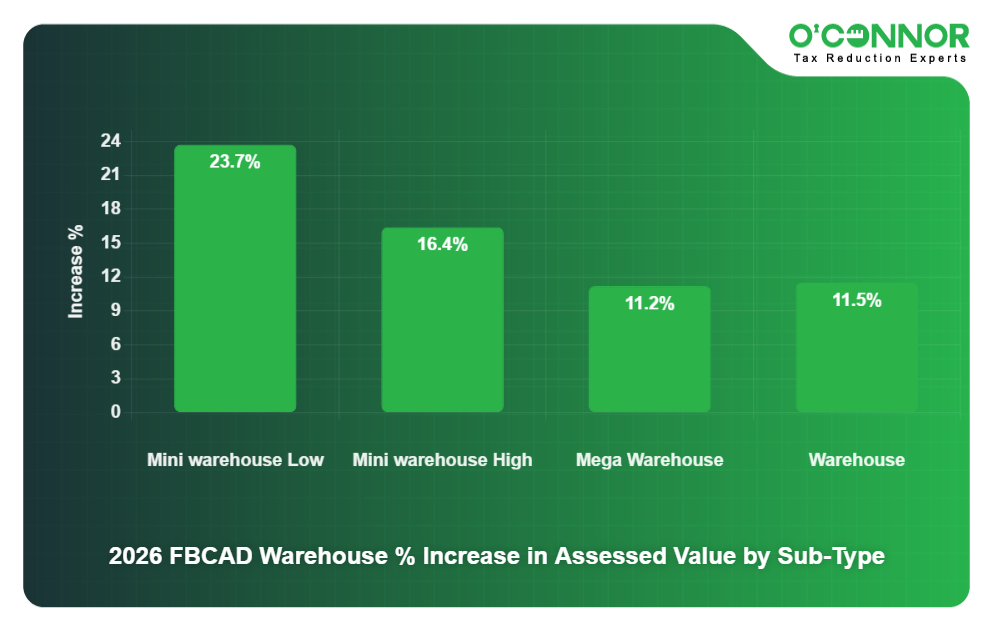
FBCAD divided warehouses into four categories, with them being surprisingly even. Standard warehouses totaled $838.94 million following a sharp increase of 7.3%. Adding 11.1%, mega warehouses came in second with $706.83 million. The two types of mini warehouses, oddly enough, were the smallest categories. Low-rise warehouses reached $414.91 million, while high-rise ones totaled $263.15 million. These did grow the most with 16% and 18.8% respectively.
High Values Require High Appeals
Fort Bend County has seen meteoric growth in the past decade, especially for commercial property. Historically, the county has seen the highest property taxes in the state. Though that dubious position has recently changed hands, Fort Bend is still one of the most taxed. The county, however, is a trend-setter in that it also embraced property tax appeal faster than any in Texas. This has allowed taxpayers to fight back against FBCAD and set the standard that the likes of Travis County are now meeting.
The people of Fort Bend County have long used professionals to help them, and we at O’Connor have been a staple of this for over 50 years. We offer full support for appeals and will help file homestead exemptions, assist with business personal property renditions, and carry out cost segregation studies. There are no upfront costs for appeals, while homestead assistance is free. Our BPP rendition services and cost segregation are both supported with some of the most competitive rates in the country.
When you enroll with us, you will get a client success consultant who will act as your single point of contact, ensuring you have a constant and accountable person to turn to. This personal touch separates our premium services from other firms. We can also send out a concierge visit to your home or business to check for other issues that could aid in your appeal, while also answering any questions you might have. You will only pay if your appeal is able to lower your taxes, and that is with a contingency fee from your winnings.