


Arguably the top real estate market in Texas, Austin and Travis County have seen their property values triple in less than a decade. This substantial increase has led to some of the highest property taxes in the state, directly impacting homeowners and business owners with larger tax bills. Thankfully, taxpayers have responded by filing some of the highest numbers of property tax appeals in the state, with over one-third of all properties being protested every year. In 2026, the Travis Central Appraisal District (TCAD) further increased valuations for both homes and businesses, intensifying the tax impact on property owners.
Travis County Residential Real Estate Adds 3.6% More Value
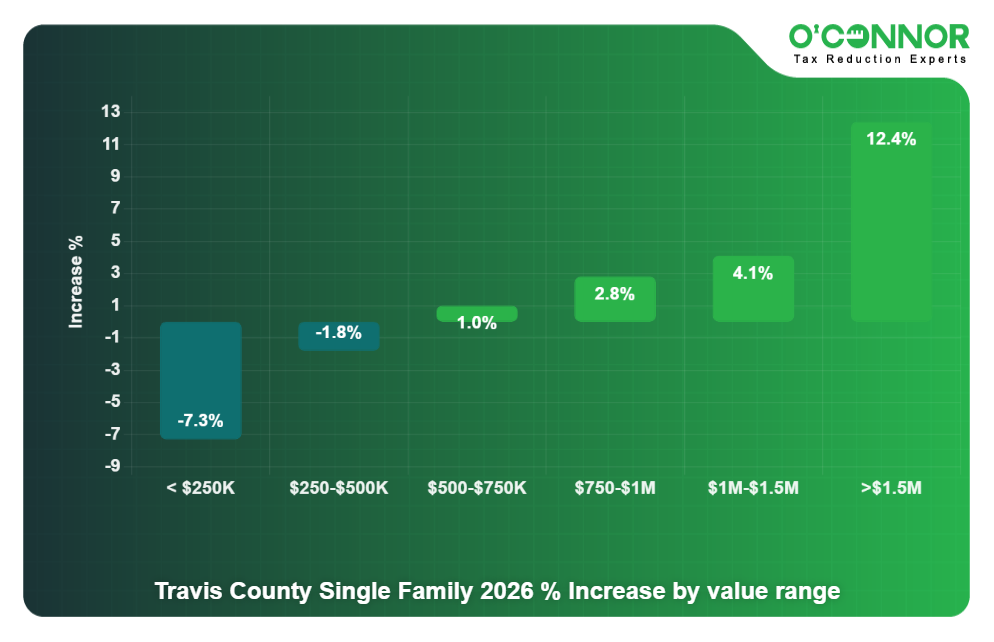
Despite already being sky-high, Travis County homes managed to add another 3.6% in value in 2026, taking the total value to $216.64 billion. This was spearheaded by homes valued at over $1.5 million, which increased by 12.4% for a total of $57.77 billion. This made these homes the top source of value, dethroning those worth between $250,000 and $500,000, which tumbled 1.8% to $56.46 billion. Homes between $500,000 and $750,000 were in third place with $40.48 billion after adding 1%. Homes worth under $250,000 dropped 7.3% in value, falling to a final sum of $2.19 billion.
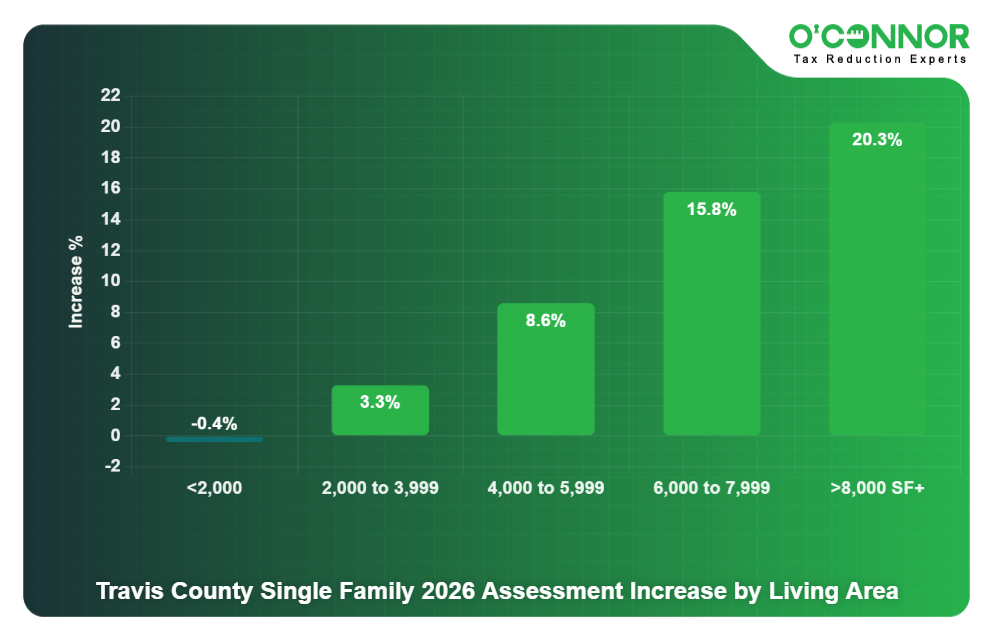
Showcasing the immense value of Travis County properties, despite high-dollar homes being the norm, there were relatively few mansions or large homes. Homes under 2,000 square feet totaled $65.90 billion, even after losing 0.4% of value. Residences between 2,000 and 3,999 square feet were the largest source of value at $106.13 billion and added 3.3%. Jumping 8.6%, houses between 4,000 and 5,999 square feet were in third place with $31.07 billion.
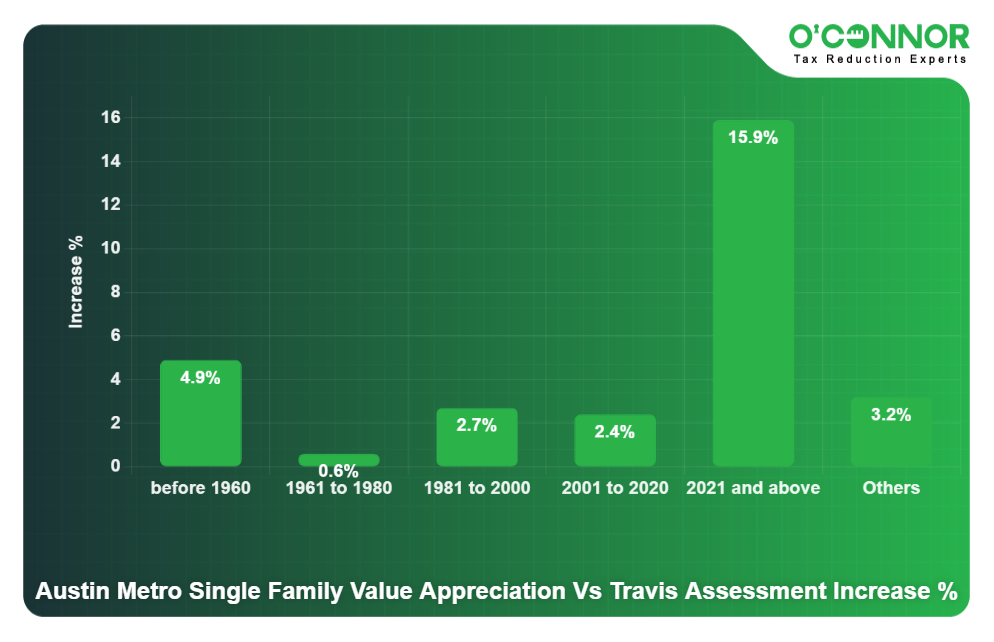
Despite growing demand, most value was not built recently, but came from previous boom periods. 39% of all residential value came from between 2001 and 2020, which equated to $84.76 billion after growing by 2.4%. After increasing 2.7%, those constructed from 1981 to 2000 reached $56.66 billion. Spiking 15.9%, new construction totaled $19.88 billion, which was 9% of all home value. Even the oldest homes shot up by 4.9%, reaching $24.37 billion.
36% of Homes Could be Overvalued
Travis County Houses Valued above/below Market Value
TCAD and other Texas appraisal districts base their values on the real estate market, though they usually lag behind by a few years. In 2026, it was estimated that 36% of homes were overassessed, while 64% were correct or even below the true market price. With over one-third of homes being overassessed, it means that homeowners in the Austin area should be diligent in going over their appraisals and should be considering appeals to make sure they are only paying their fair share.
Real Austin Home Values Could be Even Higher
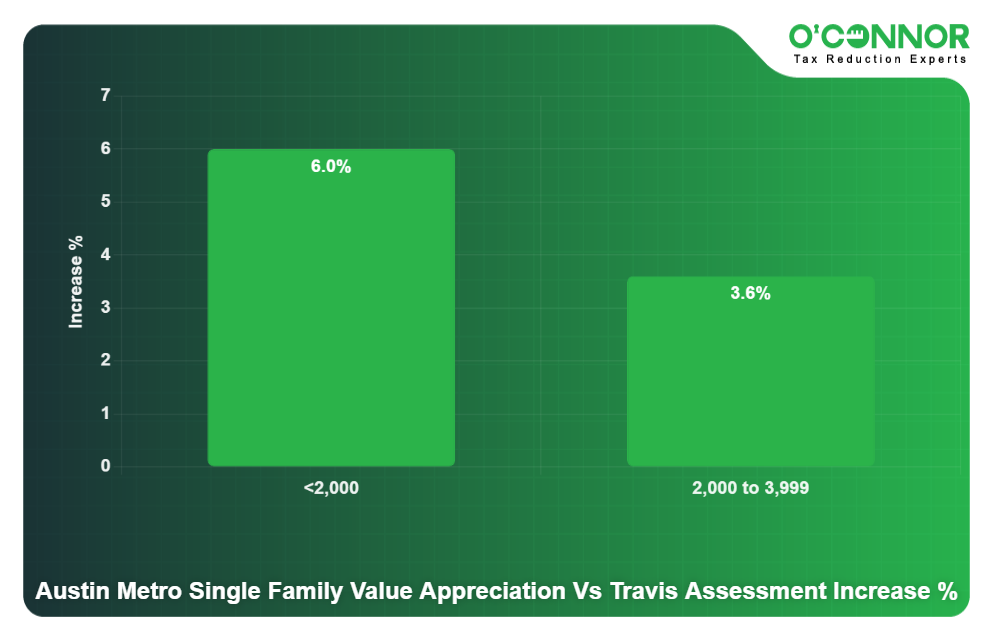
Since TCAD’s study of real estate sales is often years out of date, they do not reflect current trends. A recent study by Austin realtors found that Travis County homes had increased 6% in value from 2025 to 2026, compared to the TCAD estimate of 3.6%. While the possibility of being assessed lower than the market is certainly advantageous, this means TCAD could shoot values up next year, even if the market cools. This leaves homeowners paying more than they should. This constant game of catch-up is why homeowners need to constantly be on top of their appraisals.
Austin-Area Businesses Increase in Value by 9.9%
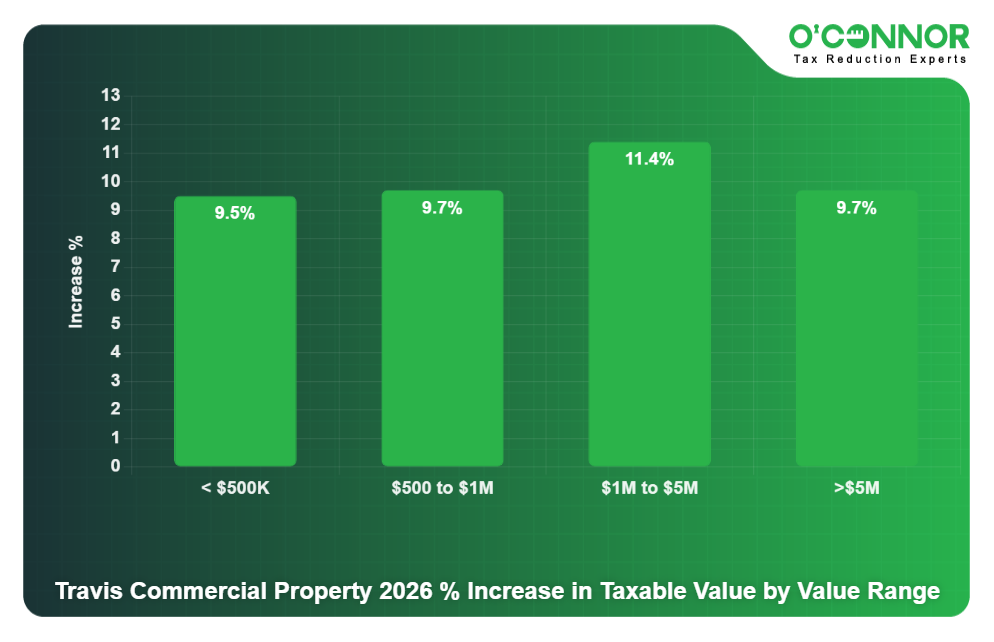
With some of the most-in-demand commercial property in the country, it should come as no surprise that Travis County added 9.9% in value in 2026. Totaling $154.03 billion, over $14 billion was added to the tax rolls. This was mostly thanks to businesses worth over $5 million, which accounted for $137.82 billion after adding 9.7%. Business real estate worth between $1 million and $5 million added 11.4%, reaching $15.34 billion overall. While they each only accounted for a fraction of the whole, businesses worth between $250,000 and $500,000, and the smallest businesses grew by 9.7% and 9.5%, respectively.
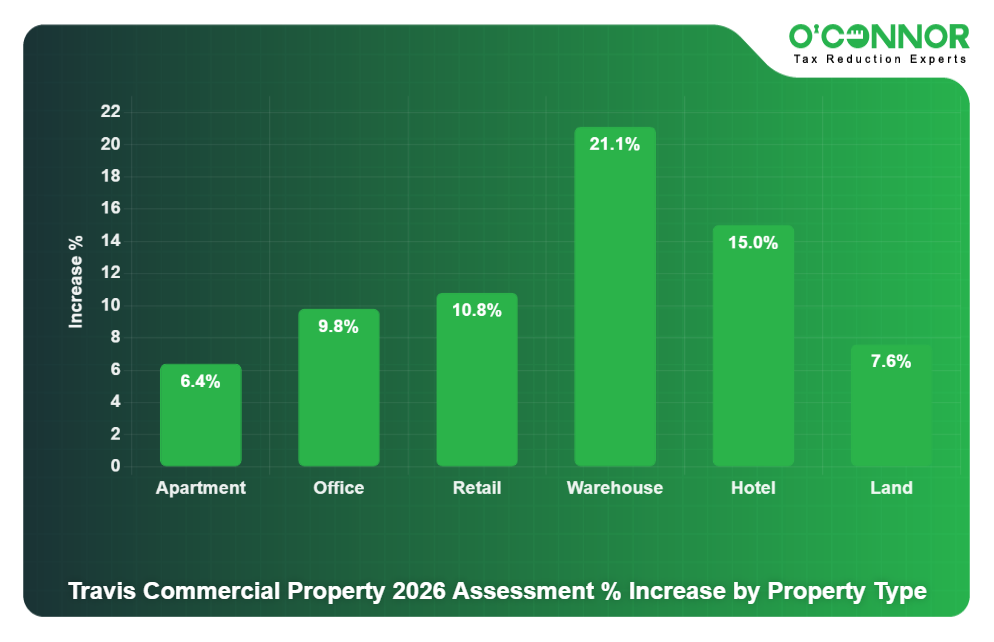
Like most urban Texas counties, Travis’ largest source of commercial value was apartments, which totaled $57.87 billion, after increasing by 5.4%. They were followed by offices at $44.50 billion and warehouses at $18.64 billion. Respectively, these jumped by 9.8% and 21.1%. Adding 7.6%, raw land accounted for $16.25 billion. The smallest category, with $8.54 billion, retail still managed to add 10.8%.
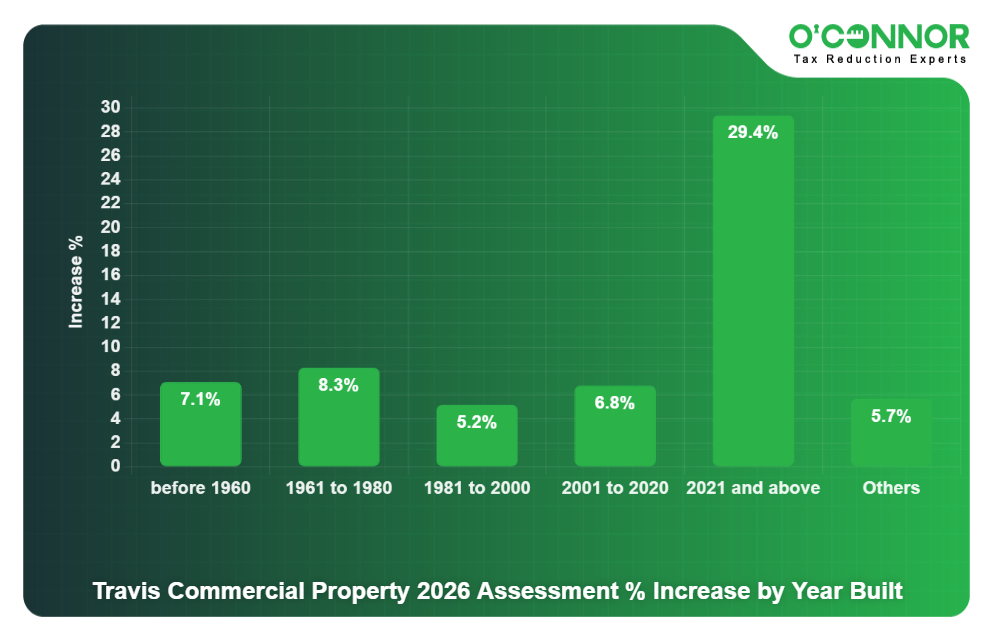
When it comes to the age of construction, commercial properties did not quite have the same recency bias as their residential brethren. Climbing by 6.8%, businesses built between 2001 and 2020 were responsible for $57.27 billion. Those from 1981 to 2000 increased 5.2% to $33.34 billion. New construction was solidly in third place with $27.31 billion, jumping an astounding 29.4% in one year. Raw land and the two older construction types all increased by at least 5%.
Commercial Property Loses Value in Most of the Country
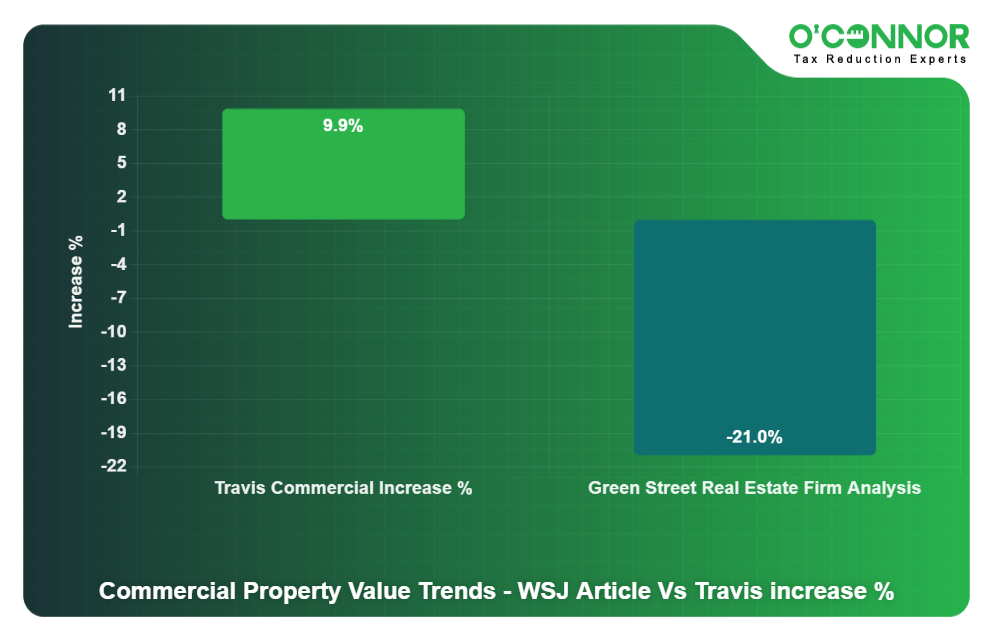
While TCAD has shown nothing but gains across the board for businesses, a study has shown that the national trend does not follow suit. Green Street estimated that commercial real estate lost 21% of its value in 2026, with several high-profile downturns. While Austin may be one of the best markets in the nation, business owners should still take their appraisals with a grain of salt and be ready to appeal every year.
Apartments Add Over $3 Billion in Taxable Value
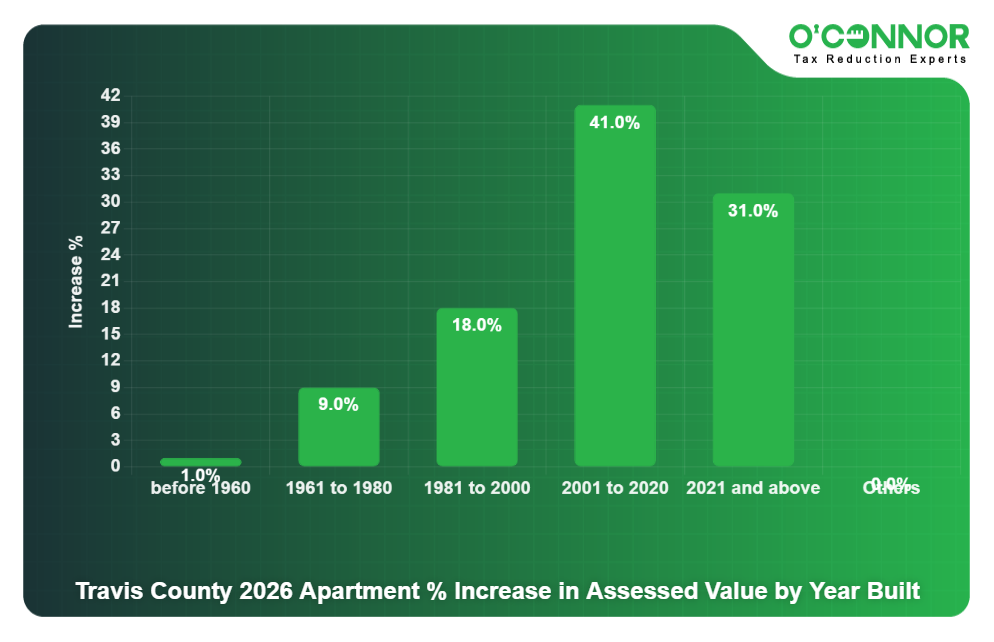
As the largest reservoir of commercial value in Travis County, any increase to the value of apartments can have an outsized impact. Climbing $6.4%, apartments added nearly $3.5 billion, bringing the total to $57.87 billion. Unlike most business real estate, most apartment value was constructed within the past few decades. 41% was built in the boom period between 2001 and 2020, while 31%, or $18.17 billion, was created by new construction. New construction soared 21% in 2026. Outside of this recent building spree, value growth was largely anemic, with the third-place category of 1981 to 2000 only adding 0.4%.
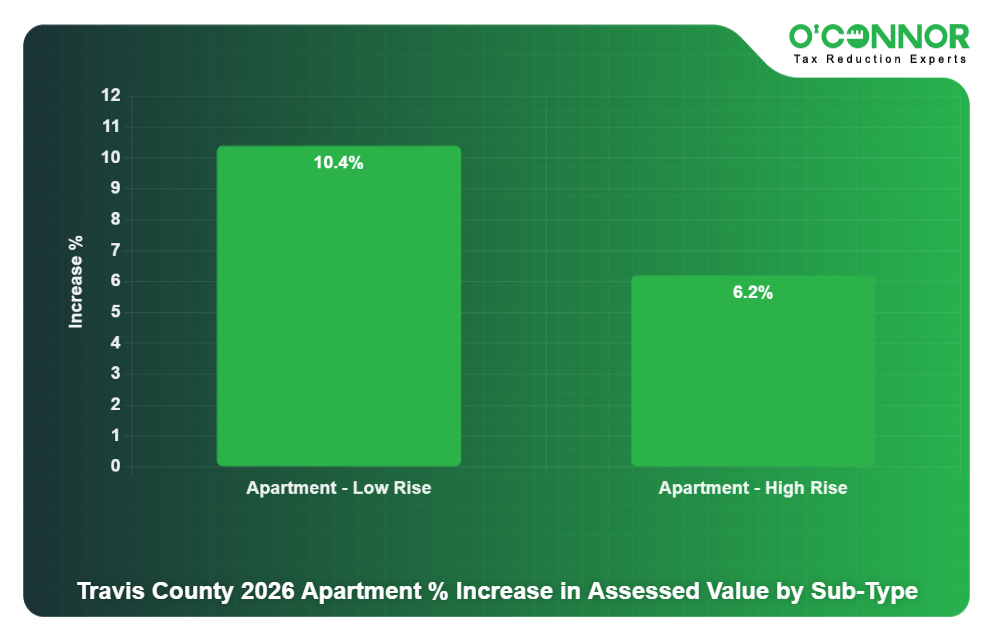
TCAD only broke apartments down into two categories. High-rise apartments were the clear winner, totaling $54.53 billion following a spike of 6.2%. Low-rise apartments jumped 10.4% to $3.34 billion.
Offices Surge 9.8%
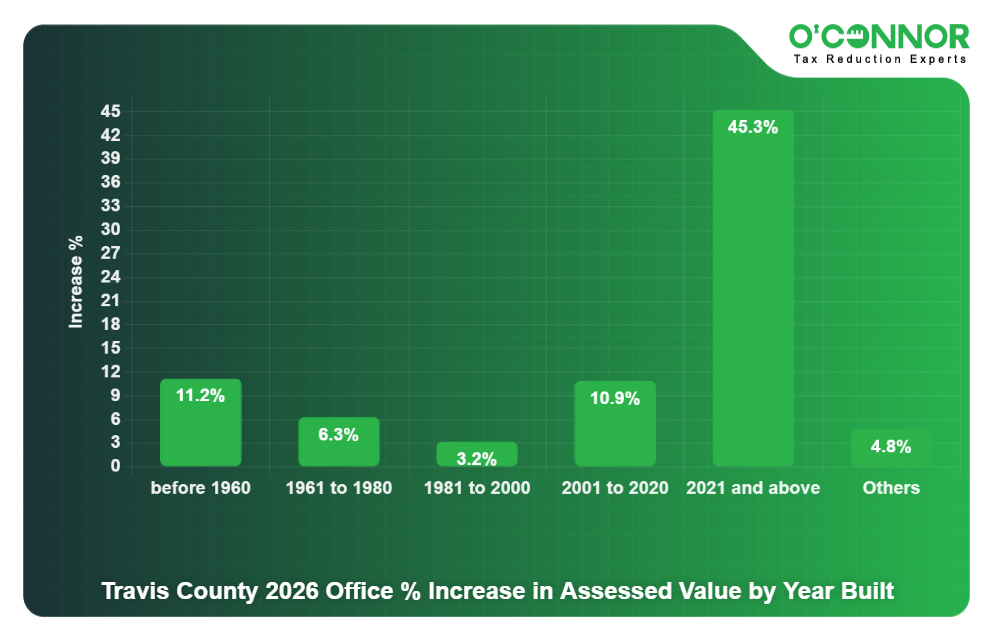
The heart of the tech industry outside of Silicon Valley, Austin, continues to see its offices gain value every year. Adding over $4 billion in taxable value in just one year, the 9.8% increase was impressive, considering offices are losing their worth all over America. New construction added a whopping 45.3%, reaching $3.50 billion. Adding 10.9%, offices built from 2001 to 2020 had the highest total with $19.17 billion, while those built from 1981 to 2000 added 3.2% to their total of $13.81 billion. Even the oldest of offices found new life, jumping 11.2%.
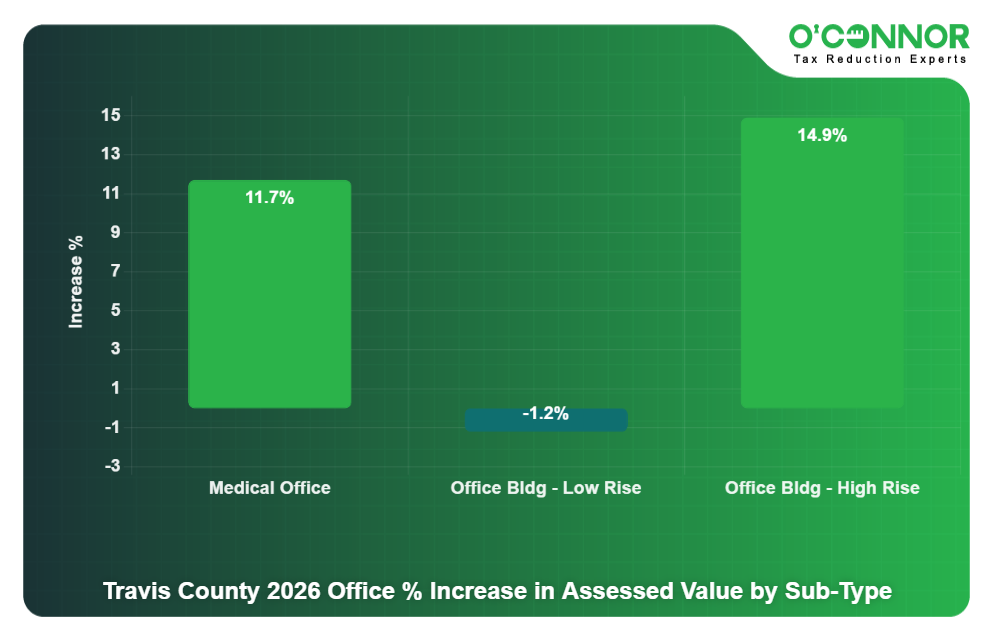
According to TCAD, offices came in three basic flavors. The largest were high-rises, which accounted for $29.78 billion after a huge jump of 14.9%. Low-rise offices managed to find a small reduction of 1.2%, falling to $12.22 billion. Medical offices saw a spike of 11.7%, which translated into a final sum of $2.91 billion.
Retail Spaces Assessed 10.8% Higher
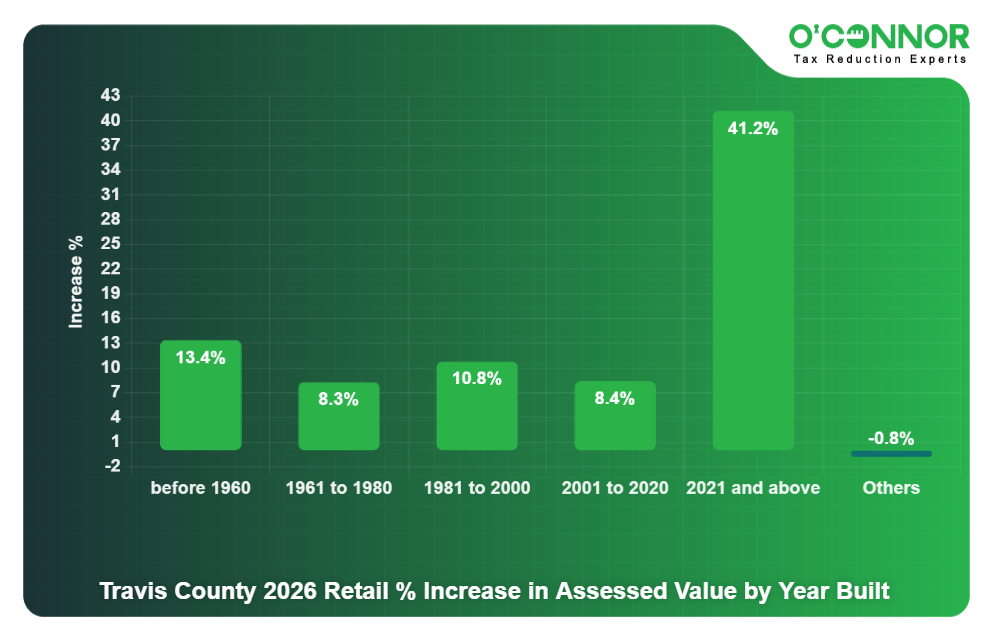
Out of all business categories, retail stores were the smallest, with a combined $8.54 billion. This was achieved following a spike of 10.8%. Retail spaces tend to lean older, though the top total was still built from 2001 to 2020, with $3.08 billion after growing by 8.4%. 1981 to 2000 contributed $2.34 billion, while those from 1961 to 1980 were responsible for $1.78 billion. These increased by 10.9% and 8.3%, respectively. New construction spiked by 41.2%, though the final sum was only $406.85 million.
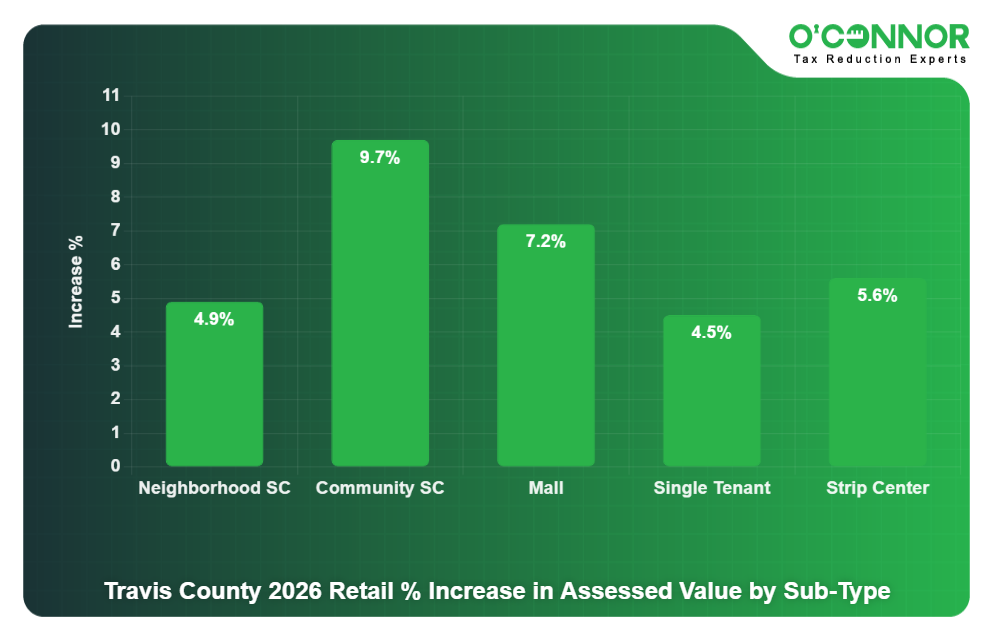
Due to their versatility, there were five categories of retail space. The largest and fastest growing were strip centers, which added 11% to total $3.79 billion. Single tenant stores jumped 10.2% to $1.30 billion, while community shopping centers added a strong 16.2% to achieve $1.60 billion. Neighborhood shopping centers increased by 6.3%, while malls added 6.9%.
Warehouses Soar 21.1%
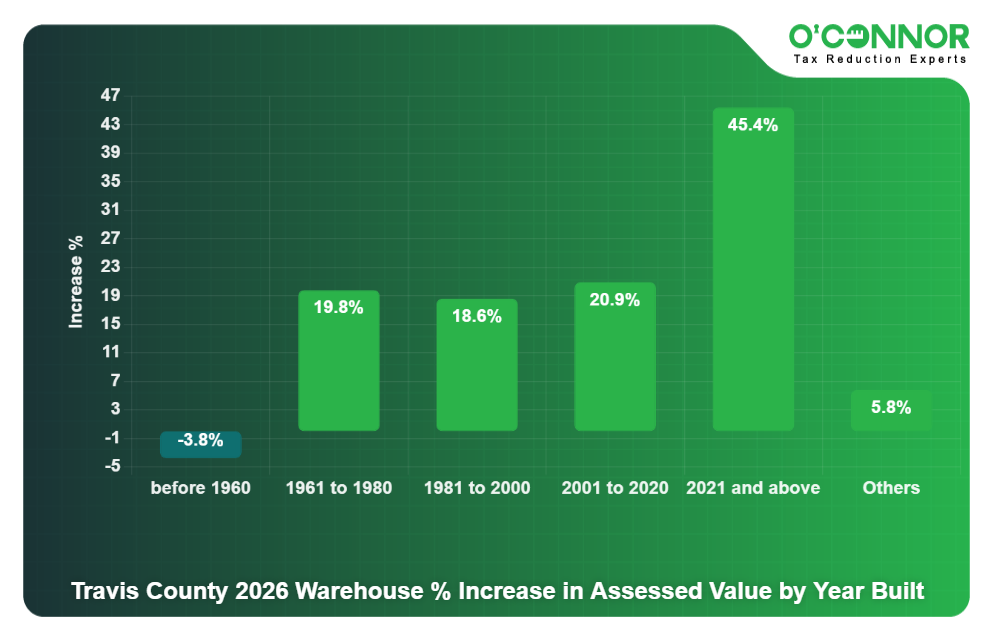
A staple of any good economy, warehouses have quickly climbed the charts in Travis County. Spiking an extreme 21.1%, these storage facilities totaled $18.64 billion in 2026. Like all construction in Travis County, the largest section of value was created by warehouses built from 2001 to 2020, which reached $5.34 billion after a large jump of 20.9%. Second place went to those built from 1981 to 2000, which likewise spiked 18.6% to a total of $5.32 billion. New construction surged 45.43% and now accounts for $3.43 billion. The only category to lose value was warehouses older than 1960, dropping 3.8%.
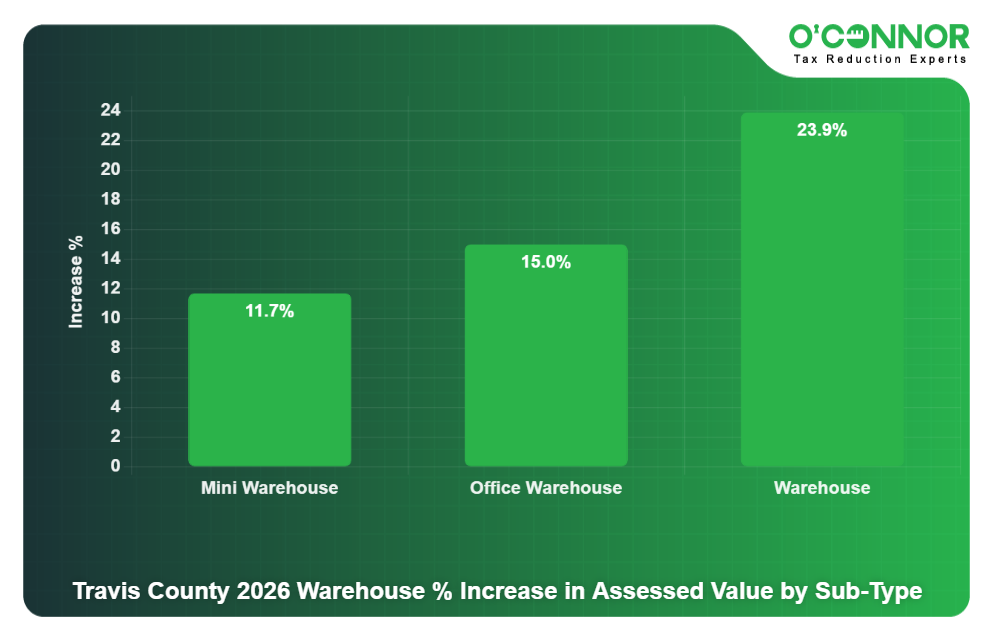
TCAD categorized warehouses into three separate groups. The largest by far was generic warehouses, which reached $13.76 billion after surging 23.9%. Office warehouses were a distant second with $2.83 billion, though they still added 15%. Mini warehouses were fittingly the smallest, with $2.04 billion, though they still grew by 11.7%.
Travis County Taxpayers Continue to Fight Increases
Thanks to a hot real estate market and aggression by TCAD, both homeowners and businesses in the Austin area have quickly learned to use appeals to stand their ground. Over one-third of all properties are appealed each year, rivaling fellow high-tax county Fort Bend. Because it can be hard to separate overassessment from market forces, it is prudent for taxpayers across the county to appeal annually, as it establishes a solid and true value for a home or business. Once established, this can be defended much more easily and can even have compounding reductions over time.
O’Connor is here to help. With over 50 years of experience fighting appraisal districts across Texas, O’Connor has been a staple for decades. We offer world-class databases that can be used to prove overassessment, unequal appraisal, and more. As one of the largest property tax consulting firmss in the nation, we have plenty of resources to bring to bear. With a branch office in Austin, we can also use local expertise to get an edge on appeals that a national brand cannot.
Besides our data and analytics, we offer all of those who join us a personal touch that few match. Upon signing up, you will be given a client success specialist. This person will be your guide, advisor, and advocate through the whole process, and you will have one familiar person to act as your point of contact. In many cases, we can send out a concierge member to your home or business, and they can assist with finding potential evidence or reductions around your property. There is no cost to join, and you will only be charged a portion of your savings if we can reduce your taxes.