


With Travis County being one of the hottest places to live and work, the demand for homes and businesses outside of Austin has reached a fever pitch. Williamson County has quickly established itself as the top suburban area of Austin and has likewise solidified its position as one of the top real estate markets in Texas. Property values in Williamson County have more than tripled in the past decade, and they continue to climb. Like the rest of the Austin area, the people of Williamson have taken to using property tax appeals at a record pace to offset these increases and have seen strong results.
Williamson County Homes Retreat 2%
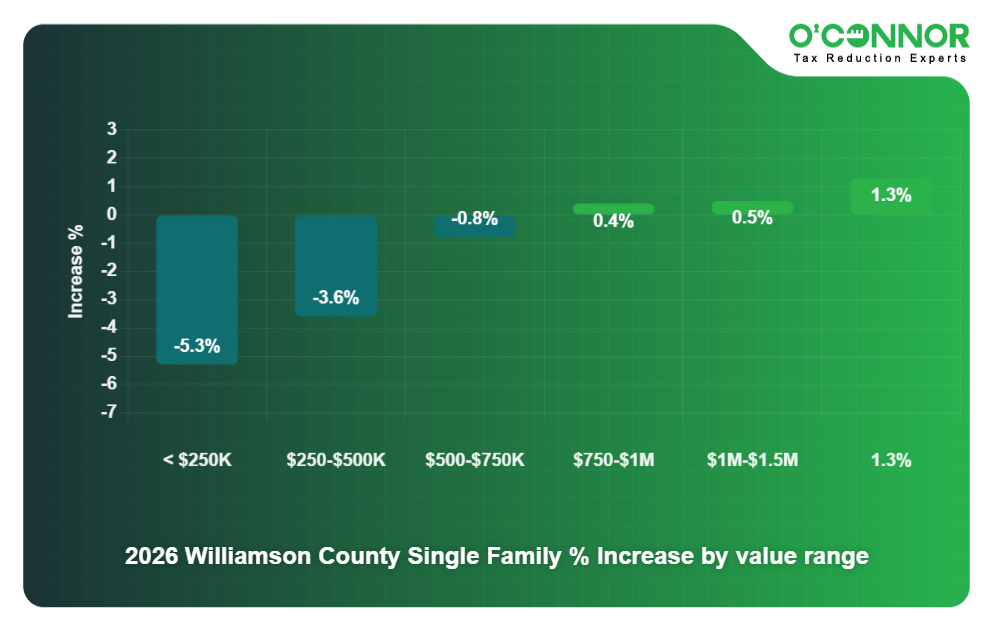
After years of rises, home values in Williamson County slowed somewhat in 2026, with around 2% of value being removed. The county as a whole still tallied an impressive $102.39 billion, compared to 2025’s $104.49 billion. The largest source of value was homes worth between $250,000 and $500,000, which still totaled $50.53 billion after losing 3.6% of their value. Homes worth between $500,000 and $750,000 were in second place with $27.94 billion, but likewise saw a retreat of 0.8%. The smallest category paradoxically had the largest reduction, as homes under $250,000 lost 5.3% of their value. The three most expensive categories of homes all added to their value, however; a trend that was also seen in Travis County.
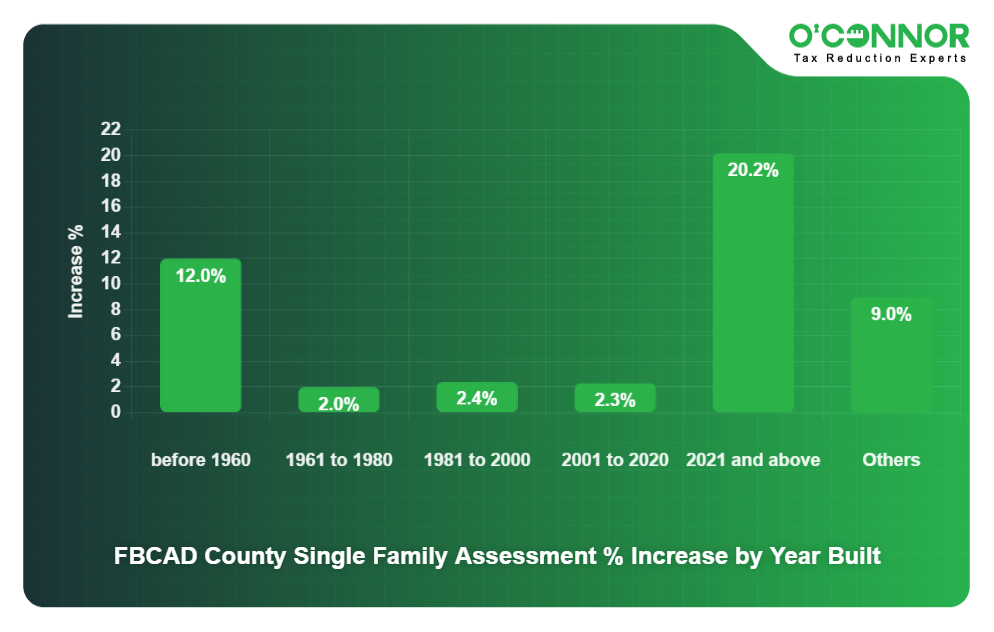
Despite value being concentrated on expensive houses, most of these were modest homes, not mansions. This shows just how valuable real estate in Fort Bend has become. With a combined sum of $80.50 billion, residences between 2,000 and 3,999 square feet were in the No. 1 spot, and also increased by 4.3%. In second place, with $22.47 billion, were homes measured between 4,000 and 5,999 square feet. The smallest homes were in third place and grew by 3.6% to total $20.19 billion. True mansions saw a strong increase of 15.8% and totaled $1.68 billion.
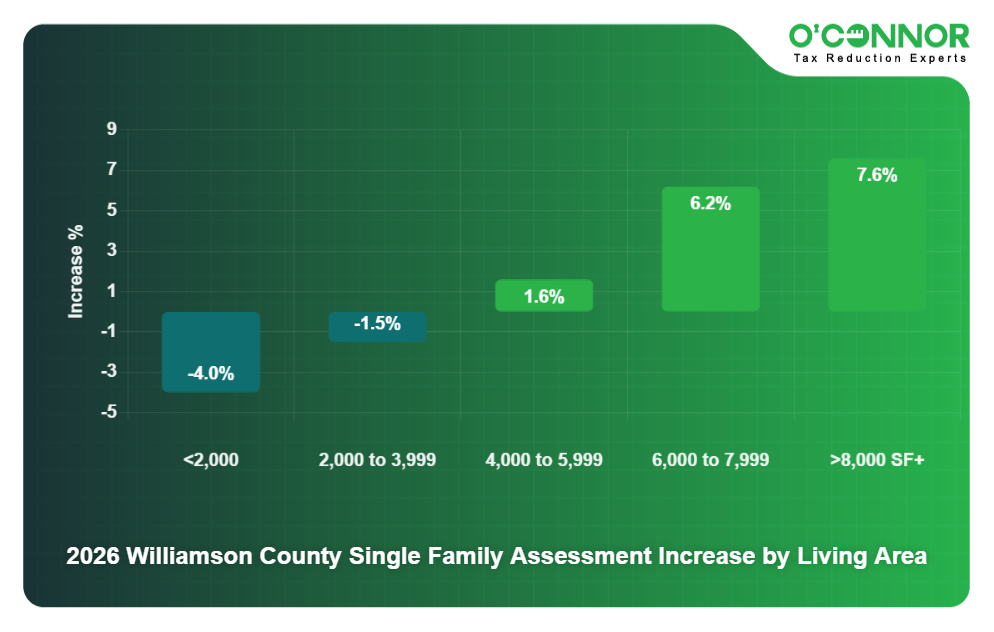
When broken down by size, it can be seen that modest homes fell in value, while larger homes only added to it. The majority of residential real estate in Williamson County measured between 2,000 and 3,999 square feet, totaling $63.78 billion after shedding 1.5% of value. $30.97 billion came from the smallest homes, which once again saw the biggest drop with 4%. Larger residential properties all saw growth; however, the total for homes between 4,000 and 5,999 square feet was $6.89 billion. Homes over 8,000 square feet added 7.6%, reaching $474.73 million, while those from 6,000 to 7,999 added 6.2%.
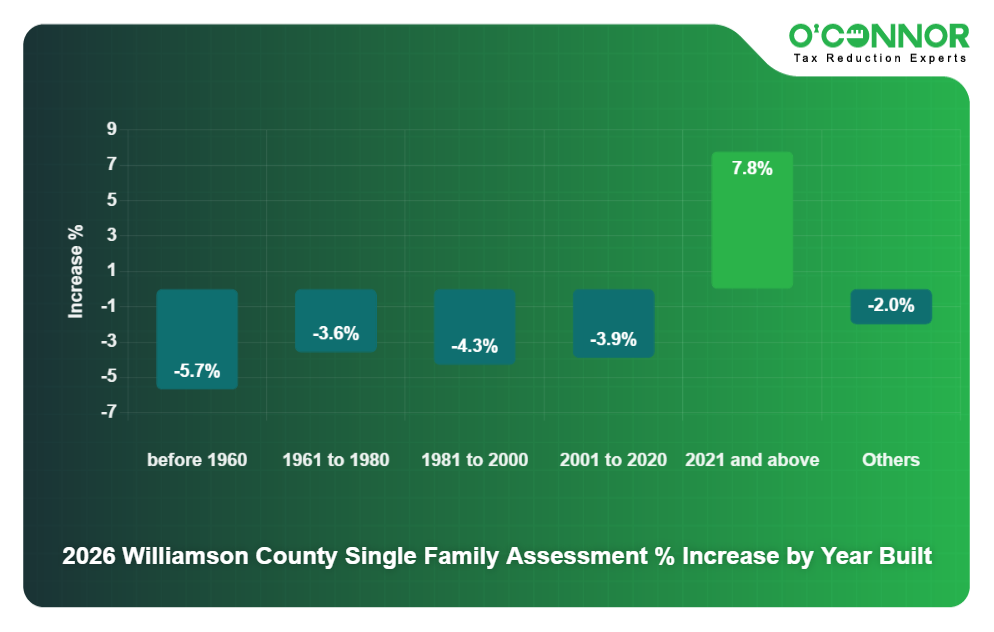
Being a fast-rising county, Williamson added most of its residential real estate value in the past few decades. Like much of Texas, the construction boom accounted for the largest portion of homes, with 50% being built from 2001 to 2020. Despite losing around 3.9% in value, these homes still tallied $51.33 billion. Dropping by 4.3%, homes built between 1981 and 2000 were worth a combined $23.93 billion. The period to see growth was new construction, which accounted for 19% of all homes, roughly $19.25 billion. These new homes added 7.8% to their total and should see even bigger gains in the coming years.
38% of Homes Still Overvalued
Houses Valued above/below Market Value based on Jan 2025 – Mar 2026 Sales
While it looks like Williamson County homes made a slight regression toward the mean in 2026, it was estimated that over 38% were still overvalued. This is a common problem in Texas, as appraisal districts tend to base their assessments on outdated housing markets. In 2025, it was estimated that around 50% of homes were overvalued, so perhaps the Williamson Central Appraisal District (WCAD) made promised adjustments to the rolls. Around one-third of properties were protested in 2025, which could also be responsible for the overall drop in value.
WCAD Underassessment?
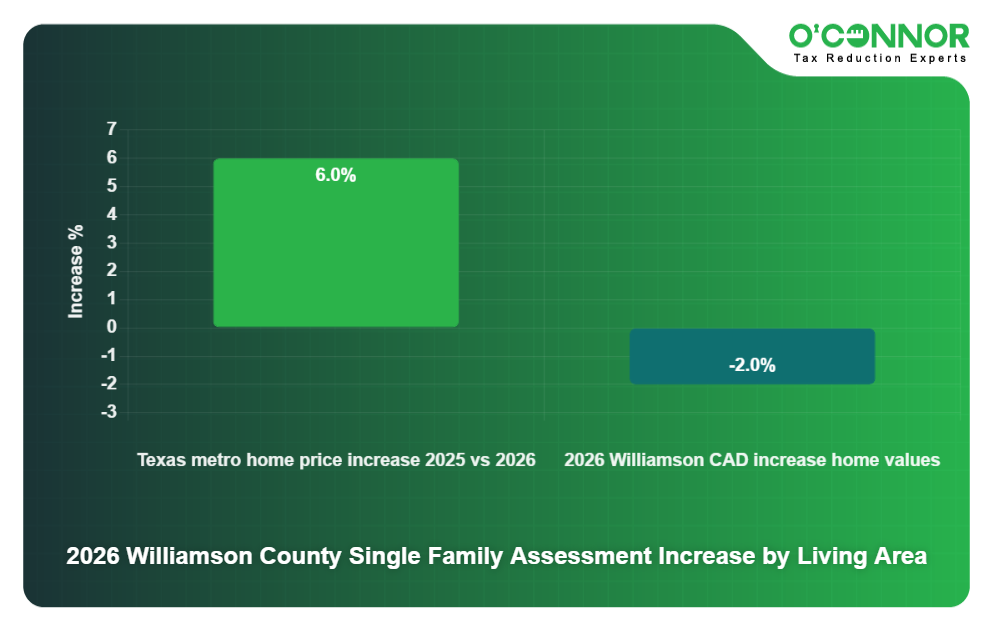
While the slight regression in values will help wallets across the county, this might be too good to be true. Austin-area realtors studied the housing market and deemed that the value of homes increased by 6% instead of shrinking by 2%. As WCAD bases their assessments on home sales, this could mean future years may see a resurgence in residential value spikes, making it harder to both buy and stay in homes. This means that taxpayers cannot give up on their record appeals, as big changes could be on the horizon.
Williamson Businesses Add 7.2% More Value
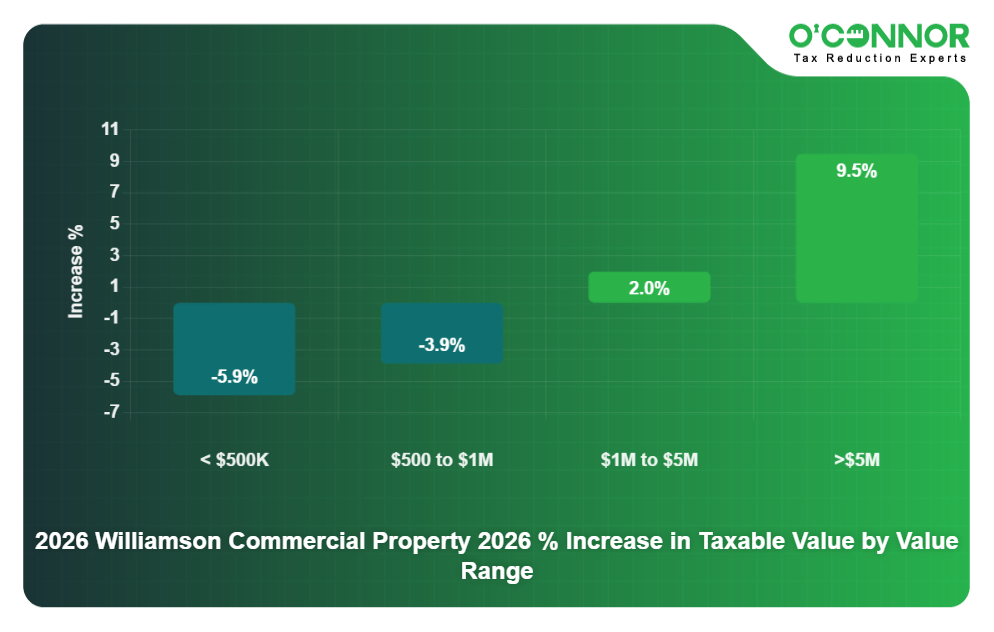
While homes managed to stall a historic trend, the same could not be said for businesses. Already seeing extensive growth in 2025, 2026 saw business property values climb by 7.2%, reaching $36.24 billion. As is typical in Texas, this was mainly thanks to the largest businesses. Commercial real estate worth over $5 million saw an increase of 9.5%, which swelled the total to $27.57 billion. Adding 2%, those worth between $1 million and $5 million accounted for $6.58 billion. While they were only responsible for around $2 billion combined, the two smallest categories each shrank significantly. Those worth under $500,000 shed 5.5%, while those worth between $500,000 and $1 million dropped 3.9%.
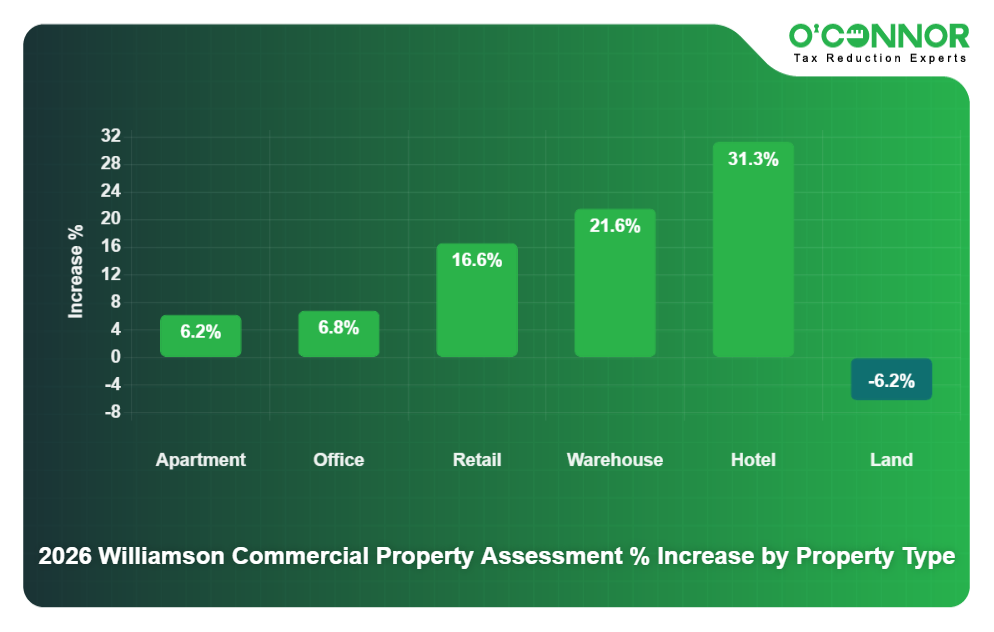
Being a residential mecca, it should be no surprise that the most valuable type of business property in Williamson County was apartments. These multifamily homes reached $13.85 billion after jumping 6.2%. Showcasing the potential of the county, raw land was worth an astounding $7.18 billion, though the value tumbled by 6.2%. While they were in fourth place in 2025, retail stores took third place thanks to a huge spike of 16.6%, supplanting offices with a combined total of $4.95 billion. Offices still managed to reach $4.62 billion after growing 6.8%. Growing by 21.6%, warehouses saw their value bloom to $3.99 billion.
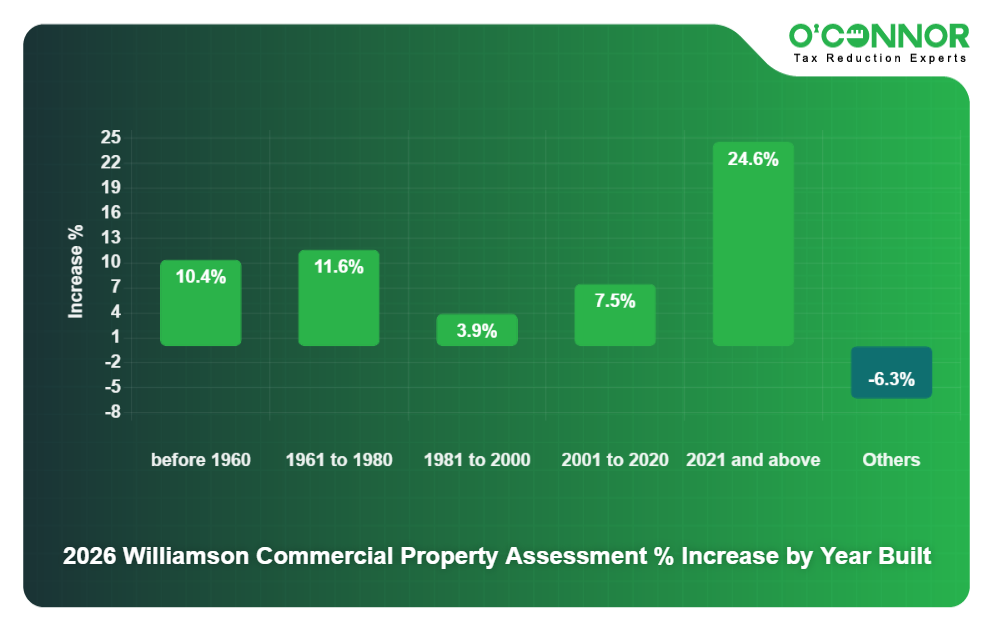
When it comes to the age of construction, businesses have even more of a recency bias than homes. While 40% of all value came from 2001 to 2020, it was the rapid growth of new construction that stole the show. Adding 24.6% in just one year, new construction accounted for 22% of all value, or $8.04 billion. After adding 3.9%, businesses from 1981 to 2000 totaled $5.74 billion. Though they totaled only around 2% of the value, the two oldest categories of commercial property still saw significant growth. It was only raw land that saw a total reduction of 6.3%.
Williamson Commercial Real Estate Surpasses the National Average
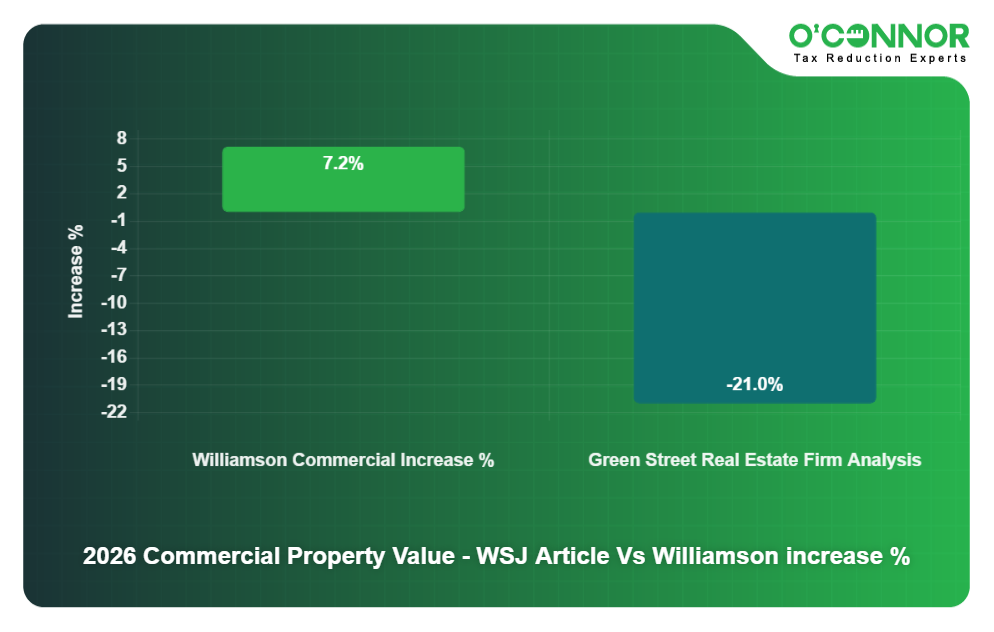
While WCAD claimed that businesses added 7.2% to their rolls, property experts at Green Street estimated that commercial property across the nation fell by 21%. This is mostly thanks to empty offices and economic uncertainty. With the Austin area being so hot, it is certainly plausible that Williamson County smoked the national average, but it still opens up the possibility of filing an appeal. Most businesses appeal annually to cut costs, so this is just more justification.
Apartments Add $800 Million
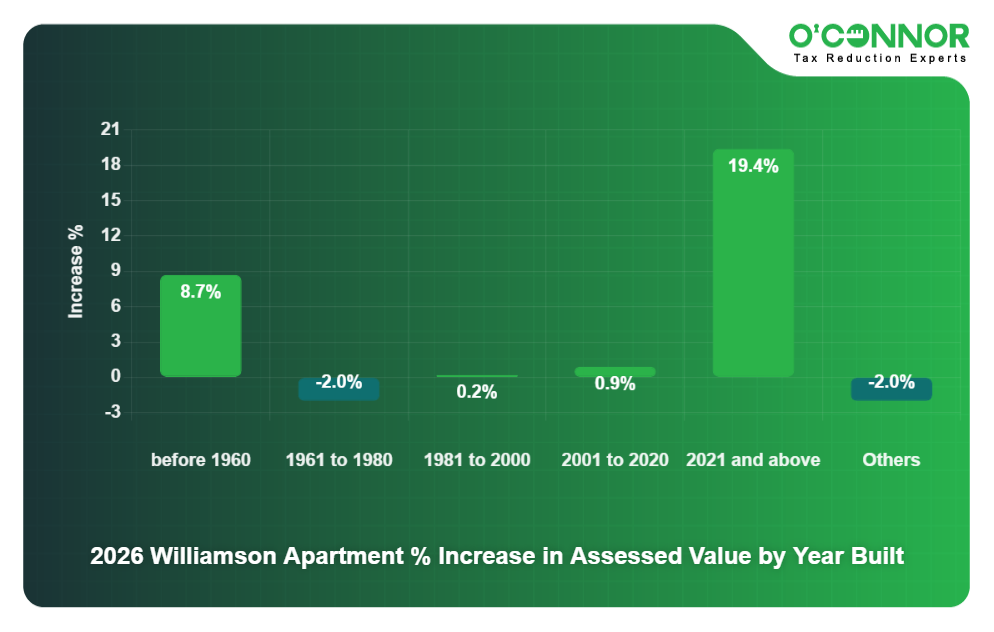
Easily still in the No. 1 spot, apartments added to their lead with a growth rate of 6.2%. Totaling $13.85 billion, multifamily homes showed a strong recency bias. $6.78 billion in value was from the 2001 to 2020 construction boom, which added 0.9% to its total. New construction did close the gap, adding 19.4% to reach $4.61 billion, or 33% of all value. While these two categories occupied 82% of all value, those constructed between 1981 and 2000 still managed to grow 0.2% to $2.37 billion.
Offices Gain 6.8%
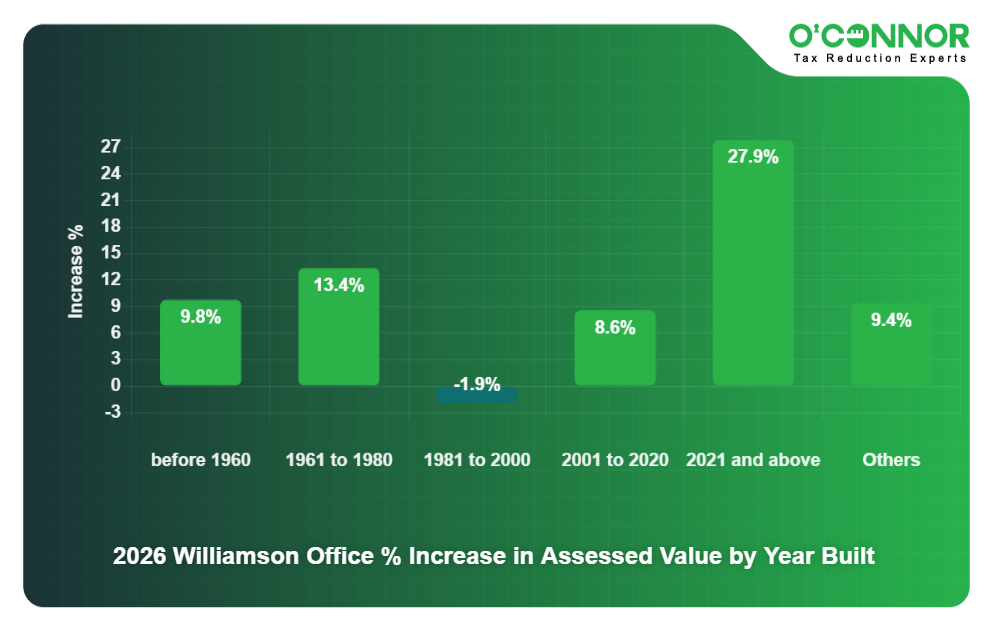
Even with many offices remaining empty, this property type added 6.8% to its total, which translated into a combined value of $4.62 billion. Due to economic realities, offices tended toward the older side more than most other real estate in the county. While 50%, or $2.56 billion, was built from 2001 to 2020, 34% of value came from those constructed from 1981 to 2000. The former added a solid 8.6%, while the latter fell by 1.9%. New construction still had an impressive presence, growing by 27.9% to $547.13 million, roughly 12% of the total. The remaining offices saw solid increases, but only accounted for roughly 4% of the total.
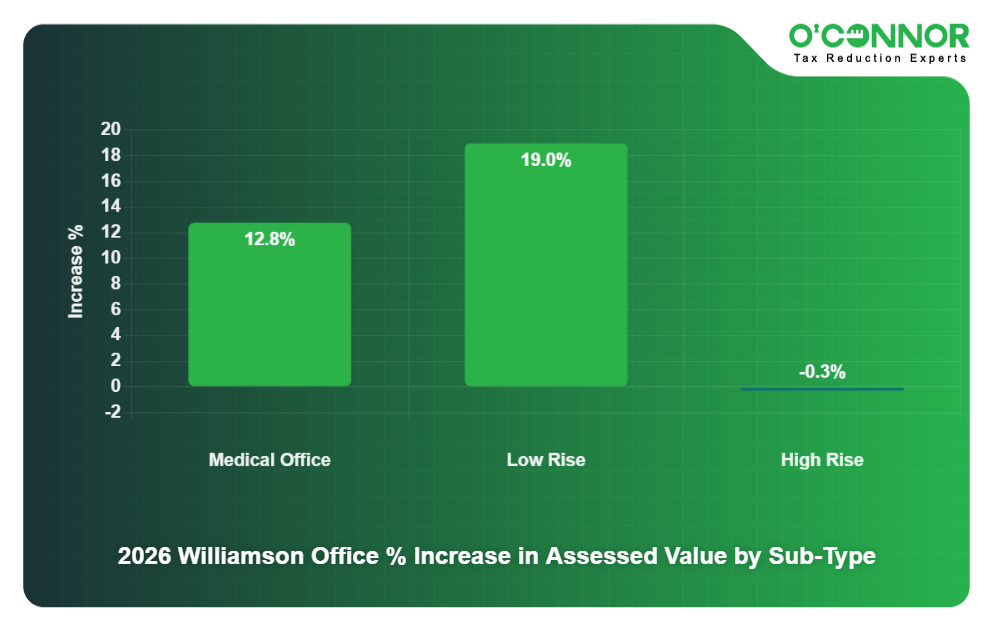
WCAD divided offices into three separate categories. High-rise offices were in the top spot with $2.42 billion, though they lost around 0.3%. Low-rise offices added 19%, which translated into a combined $1.14 billion. Medical offices also saw an impressive climb of 12.8%, which was good enough for $1.05 billion.
Retail Takes Third Place
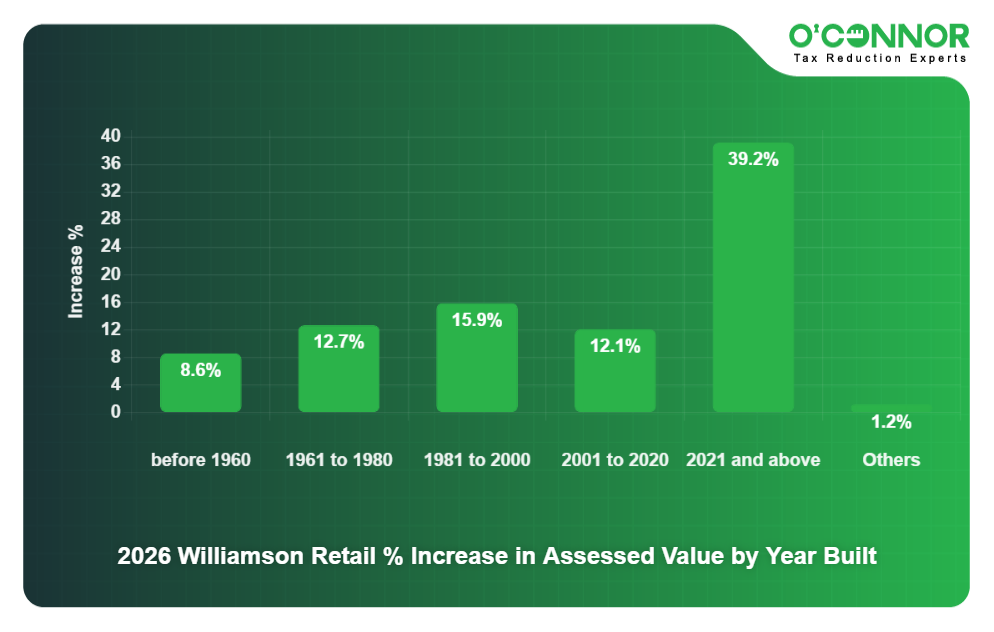
With a staggering growth rate of 16.6%, retail spaces managed to take the fourth spot in total value, upsetting offices. Jumping 12.1%, stores from the construction boom of 2001 to 2020 achieved a total of $2.63 billion, around 53% of all value. Growing by 15.9%, those from 1981 to 2000 achieved $1.22 billion. New construction did come on surprisingly hard, soaring 39.2% to $774.97 million. Raw land and the two older categories combined for around 6% of the remaining total, though all three did see increases.
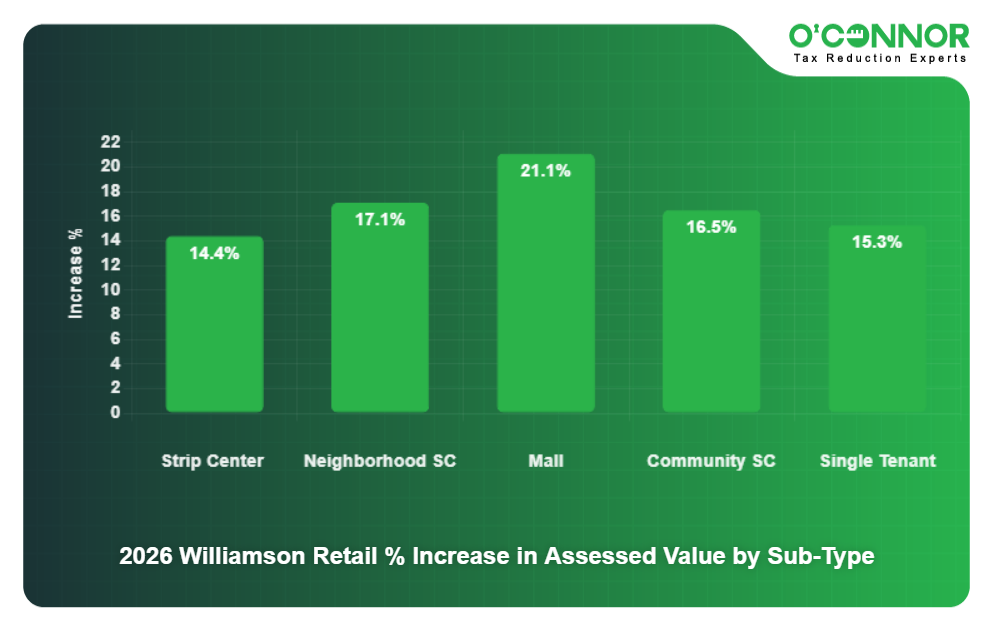
Retail spaces had the most variety when it came to categories. The largest was the signature Texas strip center, which accounted for $1.80 billion after adding 14.4%. In second place were malls, which shot up an unexpected 21.1% to total $1.13 billion. Neighborhood shopping centers added a stunning 17.1% to total $794 million, while single-tenant big box stores jumped 15.3% to $789 million. Community shopping centers also grew 16.5% to $422.79 million.
Warehouses Soar 21.6%
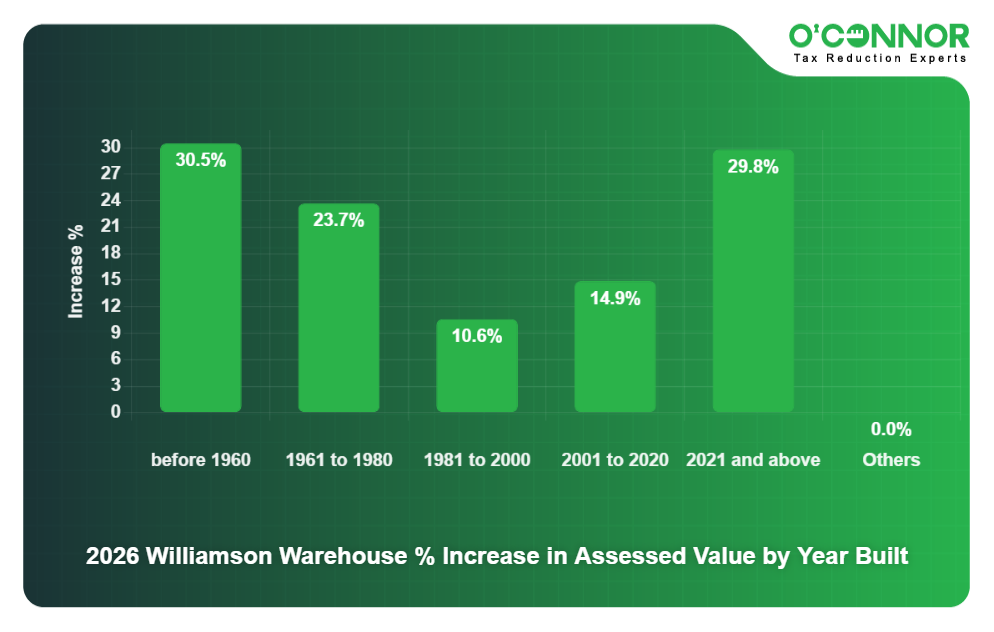
Outside of hotels, no commercial real estate saw its taxable value grow like warehouses. Already the fastest-growing property type of 2025, these storage mavens added 21.6% to their total, translating into a final tally of $3.99 billion. Warehouses broke the established mold, with 50% of all value being thanks to new construction, as those built from 2021 to present added 29.8% to reach $1.99 billion. Jumping 14.9%, those from 2001 to 2020 achieved $1.53 billion, while those from 1981 to 2000 managed to total $382 million after a bump of 10.6%. Even older warehouses saw extensive increases, even if they accounted for only 2% of the total.
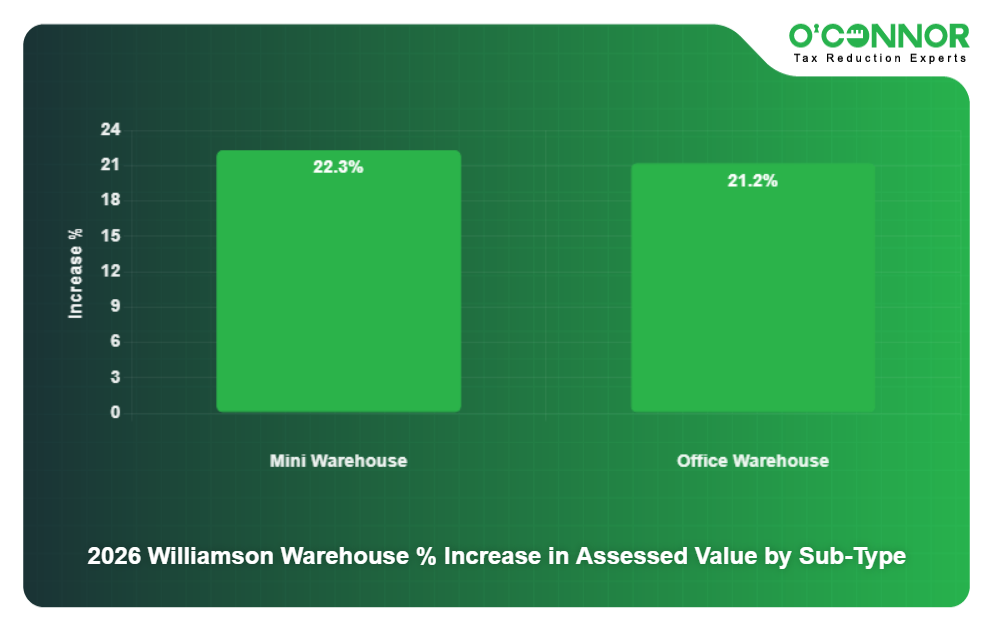
WCAD categorized warehouses into only two classes. Office warehouses were the larger of the two, totaling $2.78 billion in value after a jump of 21.2%. Mini warehouses were smaller, increasing 22.3% to $1.21 billion.
Record Appeals Should Continue
While homeowners saw a bit of relief from WCAD in 2026 with more conservative valuations, now is not the time for the people of Williamson County to rest on their laurels. Home valuations may be down a tick in 2026, but with the hot housing market, they could easily shoot back up. Not to mention, housing prices are still at all-time highs. With around one-third of all properties being protested, the pressure against WCAD needs to continue. Appeals not only lead to reductions, but they also create accountability.
If your home or business needs protection from high values and taxes, then you should consider partnering with O’Connor for your appeals, exemptions, and more. For over 50 years, O’Connor has been a constant mainstay for Texans fighting their property values and taxes. We offer a winning combination of both national resources and local expertise, besting firms both big and small. We will help you with your homestead exemption for free, and there is no cost to sign up for an appeal.
When you join O’Connor, you will get a client success consultant who will be your full-time guide and point of contact. This gives you a consistent and accountable person to turn to for all of your questions. Many of our clients can also get a concierge visit, where a team member will come out to your home or business. With a peerless personal touch and a long history of success, we at O’Connor are happy to help you on your quest for savings and fair taxation.